This topic distinguishes stopping (waiting), which is brief, from parking, where you leave the vehicle. Park parallel to the road unless a sign or marking allows otherwise. A blue disc with one red line means no parking, while a red X means no stopping at all. You may not stop on pedestrian crossings, sidewalks, bends, crossroads, in front of entrances or in the middle of the road. Keep at least 15 m from traffic lights and bends, 7 m from a fire hydrant and 20 m from tunnels and bridges. Yellow marks no-parking areas, and a broken-down vehicle must be made visible.
Question 1What is the difference between stopping (waiting) and parking?
AStopping is with the engine off; parking is with it running
BThere is no difference
CStopping is for a short, limited time; parking is stopping and leaving the vehicle ✓(correct answer)
DStopping is only at night; parking is only by day
Correct answer: C. Stopping/waiting is a short and limited stop; parking means stopping the vehicle and leaving it parked.Source: Handbook p. 208
Question 2You stop briefly at the roadside to let a passenger get out, then drive on. What is this called?
AOvertaking
BParking
CAbandoning the vehicle
DStopping (waiting) ✓(correct answer)
Correct answer: D. Stopping the vehicle for a short and limited period is stopping/waiting, not parking.Source: Handbook p. 208
Question 3You stop your car and leave it to go shopping. What is this called?
APausing
BLane changing
CParking ✓(correct answer)
DStopping (waiting)
Correct answer: C. Parking means stopping the vehicle and leaving it parked.Source: Handbook p. 208
Question 4In a place where parking is allowed and no sign says otherwise, how should you park?
AParallel to the side of the road or the sidewalk ✓(correct answer)
BIn any direction you like
CAt a right angle to the sidewalk
DDiagonally across two spaces
Correct answer: A. Vehicles are parked parallel to the side of the road or sidewalk, unless a sign indicates another way.Source: Handbook p. 209
Question 5When may you park at an angle or perpendicular to the sidewalk instead of parallel?
AWhen a sign or marking indicates that way of parking ✓(correct answer)
BNever
CWhenever there is enough space
DOnly at night
Correct answer: A. Parking another way is allowed if there is a sign indicating it.Source: Handbook p. 209
Question 6What does this sign mean?
AParking for disabled drivers only
BNo stopping or waiting at all
CEnd of all parking restrictions
DWaiting (brief stopping) is allowed, but parking is not ✓(correct answer)
Correct answer: D. One red diagonal on a blue disc: you may stop briefly, but you may not park.Source: Handbook p. 210
Question 7What does this sign mean?
AParking allowed on both sides
BWaiting allowed, no parking
CNo standing or waiting (no stopping) ✓(correct answer)
DCrossroads ahead
Correct answer: C. The red X on a blue disc forbids stopping and waiting completely.Source: Handbook p. 210
Question 8You want to drop off a passenger for a few seconds. Under which sign is this NOT allowed?
AA blue disc with one red diagonal line
BA white parking-bay line
CA blue disc with a red X ✓(correct answer)
DA blue 'P' sign
Correct answer: C. The red X means no standing or waiting. The single diagonal allows waiting, just not parking.Source: Handbook p. 210
Question 9Where does a parking prohibition shown by a sign end?
AAt the next traffic light
BOnly at a sign showing the end of the prohibition
CAt the first turn after the sign ✓(correct answer)
DAfter exactly 100 m
Correct answer: C. The handbook says the parking prohibition ends at the first turn after the sign.Source: Handbook p. 210
Question 10If the kerb or parking lines are painted white, what does this mean?
AOnly buses may stop
BStopping is completely forbidden
COnly emergency vehicles may stop
DThere are no restrictions on stopping vehicles ✓(correct answer)
Correct answer: D. White lines mean there are no restrictions on stopping vehicles.Source: Handbook p. 211
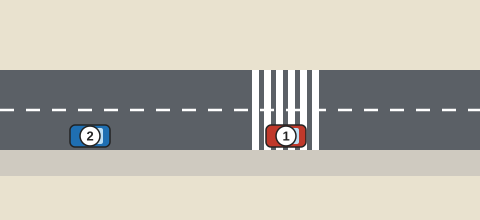
Question 11Car 1 has stopped as shown. Is this allowed?
AYes, if the hazard lights are on
BNo, stopping on a pedestrian crossing is forbidden ✓(correct answer)
CYes, if no pedestrians are crossing
DYes, for up to two minutes
Correct answer: B. It is forbidden to stop the vehicle on pedestrian crossings.Source: Handbook p. 212
Question 12Is it allowed to stop or park your vehicle on the sidewalk?
AYes, at night only
BYes, if two wheels stay on the road
CYes, if the hazard lights are on
DNo, it is forbidden ✓(correct answer)
Correct answer: D. Stopping and parking on the sidewalk are both forbidden.Source: Handbook p. 212
Question 13How close to a schoolchildren crossing place may you stop?
ARight at the crossing, if no children are present
BNot less than 50 cm, if the engine is running
CNot less than 1.5 m from it ✓(correct answer)
DNot less than 0.5 m from it
Correct answer: C. It is forbidden to stop less than one and a half metres from the crossing place of schoolchildren.Source: Handbook p. 212
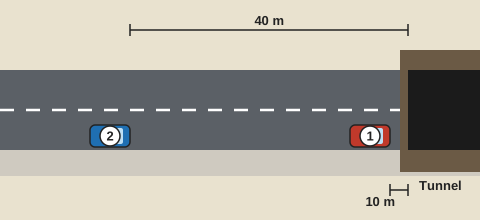
Question 14Car 1 is parked 10 m before a tunnel entrance. Is this allowed?
AYes, outside working hours
BNo, parking within 20 m of a tunnel is forbidden ✓(correct answer)
CYes, the minimum is 5 m
DYes, if the hazard lights are on
Correct answer: B. Parking is prohibited at a distance of 20 m or less from tunnels. Car 2 (40 m away) is fine.Source: Handbook p. 213
Question 15What is the rule for parking near or on bridges?
AParking on a bridge is allowed with hazard lights
BParking is forbidden within 5 m of a bridge only
CParking on a bridge, or within 20 m of a bridge, is forbidden ✓(correct answer)
DOnly parking under the bridge is forbidden
Correct answer: C. It is forbidden to park on bridges and at a distance of 20 m or less from them.Source: Handbook p. 213
Question 16Within what distance of a tunnel or a bridge is parking forbidden?
A7 m or less
B20 m or less ✓(correct answer)
C15 m or less
D50 m or less
Correct answer: B. Tunnels and bridges: no parking within 20 m (and none on bridges).Source: Handbook p. 213
Question 17Which of these is a place where parking is forbidden?
ABeside the kerb on a straight road with white lines
BIn a marked parking bay
CAt a bend (turn) in the road ✓(correct answer)
DIn a parking lot
Correct answer: C. It is forbidden to park at any turn, at crossroads and on the sidewalk.Source: Handbook p. 213
Question 18May you park at a crossroads?
ANo, parking at crossroads is forbidden ✓(correct answer)
BYes, if you keep to the right
CYes, at night
DYes, if there is no traffic light
Correct answer: A. Crossroads are among the places where parking is forbidden.Source: Handbook p. 213
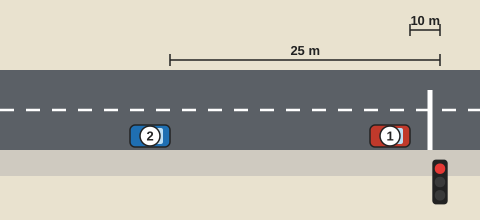
Question 19Which car has stopped in a forbidden place?
ABoth cars
BCar 1, because it is less than 15 m from the traffic light ✓(correct answer)
CNeither car
DCar 2, because it is more than 20 m from the traffic light
Correct answer: B. Stopping less than 15 m from a traffic light is forbidden. Car 2 at 25 m is fine.Source: Handbook p. 214
Question 20At an intersection with traffic lights, how far from the traffic light must you stay if you stop your vehicle?
AAt least 15 m ✓(correct answer)
BAt least 1.5 m
CAt least 5 m
DAt least 7 m
Correct answer: A. Stopping less than 15 m from a traffic light is forbidden.Source: Handbook p. 214
Question 21How far from a bend must you stay if you stop your vehicle?
AAt least 7 m
BAt least 3 m
CAt least 1.5 m
DAt least 15 m ✓(correct answer)
Correct answer: D. It is forbidden to stop less than 15 m from a bend.Source: Handbook p. 214
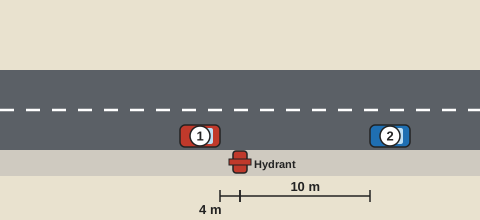
Question 22Which car is parked in a forbidden place?
ACar 1, because it is less than 7 m from the fire hydrant ✓(correct answer)
BBoth cars
CCar 2, because it is more than 7 m from the hydrant
DNeither car
Correct answer: A. Stopping less than 7 m from a fire hydrant is forbidden.Source: Handbook p. 215
Question 23What is the minimum distance from a fire hydrant at which you may stop?
A20 m
B1.5 m
C15 m
D7 m ✓(correct answer)
Correct answer: D. It is forbidden to stop the vehicle less than 7 m from a fire hydrant.Source: Handbook p. 215
Question 24May you stop your vehicle in front of a building's entrance or exit?
AYes, if you stay in the vehicle
BYes, at night only
CYes, for up to 5 minutes
DNo, stopping in front of entrances or exits is forbidden ✓(correct answer)
Correct answer: D. It is forbidden to stop the vehicle in front of entrances or exits.Source: Handbook p. 215
Question 25You park in a space marked for disabled drivers only, but you don't have a permit. What can happen?
ANothing, if the car park is empty
BNothing, if you are back within 10 minutes
CYou only get a verbal warning
DYour vehicle can be towed (and you commit a violation) ✓(correct answer)
Correct answer: D. Parking in places designated for a certain category of vehicle is forbidden; the sign shown says towing charges apply.Source: Handbook p. 215
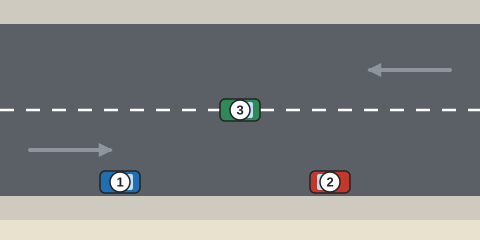
Question 26Which car is stopped correctly?
ACars 2 and 3
BCar 1 ✓(correct answer)
CCar 3
DCar 2
Correct answer: B. Car 1 is at the edge in the direction of traffic. Car 2 faces against traffic and car 3 is in the middle of the road; both are forbidden.Source: Handbook p. 216
Question 27Why is car 2 parked incorrectly?
AIt is facing the opposite direction of traffic ✓(correct answer)
BIt should be parked in the middle of the road
CIt is parked on the right side
DIt is too close to the sidewalk
Correct answer: A. It is forbidden to stop in the opposite direction of traffic.Source: Handbook p. 216
Question 28Is it allowed to stop your vehicle in the middle of the road?
ANo, it is forbidden ✓(correct answer)
BYes, for less than one minute
CYes, if the hazard lights are on
DYes, on one-way streets
Correct answer: A. Stopping in the middle of the road is forbidden.Source: Handbook p. 216
Question 29Your vehicle breaks down on a motorway. What should you do first, if possible?
APush it to the left-most lane
BLeave it in the lane and walk to get help
CMove the vehicle off the road ✓(correct answer)
DStop in the middle lane so others can see it
Correct answer: C. If a vehicle breaks down on a motorway, it should be moved off the road if possible.Source: Handbook p. 216
Question 30Your broken-down vehicle has to stay at the roadside at night. What must you do?
APut white lights on the rear
BPlace red lights on it so other vehicles don't collide with it ✓(correct answer)
CLeave it without lights to save the battery
DTurn on the high beams
Correct answer: B. At night, red lights must be placed on a disabled vehicle; by day it needs well-visible warning signals.Source: Handbook p. 216
Question 31Your broken-down vehicle has to stay at the roadside in the daytime. What does the handbook require?
AIt must be equipped with well-visible warning signals ✓(correct answer)
BThe high beams must be on
CNothing in daylight
DOnly the interior light must be on
Correct answer: A. In the daytime a disabled vehicle must be equipped with well-visible warning signals.Source: Handbook p. 216
Question 32Outside the city, on a winding road, you want to stop on the bend for a photo. Is this allowed?
AYes, outside cities there are no stopping rules
BYes, if you are quick
CYes, if you stop on the inside of the bend
DNo, stopping is forbidden where a parked vehicle endangers public safety ✓(correct answer)
Correct answer: D. On public roads outside the city, stopping is forbidden if parked vehicles pose a danger to public safety.Source: Handbook p. 216
Question 33On public streets, which colour marks an area where parking is prohibited?
AYellow ✓(correct answer)
BBlue
CGreen
DWhite
Correct answer: A. No-parking areas are painted yellow. White lines mean there is no restriction on stopping.Source: Handbook p. 211