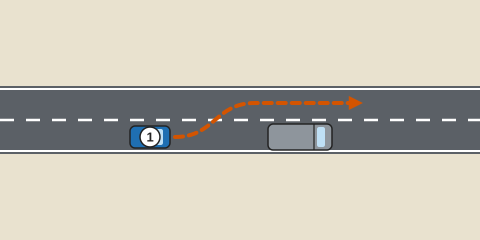
Before you start to overtake, several conditions must be met, and this topic covers them. The handbook considers a speed difference of at least 20 km/h, within the limit, as good for overtaking, so a 100 km/h limit with a truck at 70 km/h works. You must check that you can keep a safe side distance, that the vehicle ahead is not starting to overtake, and that no one is overtaking you. Ahead, make sure you will not obstruct oncoming traffic, that there are no curves or crossings, and that there is room to return to the right.
Question 1What speed difference does the handbook consider good for overtaking?
AAt least 50 km/h faster
BAt least 5 km/h faster
CAny speed difference, as long as you exceed the limit only briefly
DAt least 20 km/h faster than the vehicle being overtaken, within the speed limit ✓(correct answer)
Correct answer: D. A good difference is at least 20 km/h, without exceeding the speed limit.Source: Handbook p. 204
Question 2The limit is 100 km/h and a truck ahead drives at 70 km/h. Using the handbook's guideline, is the speed difference enough to overtake?
ANo, trucks may never be overtaken
BYes, but only at 120 km/h
CYes, you can overtake at up to 100 km/h, a difference of 30 km/h ✓(correct answer)
DNo, you would need to drive at 130 km/h
Correct answer: C. You need at least 20 km/h more without exceeding the limit; 70 + 20 = 90 km/h, which is within 100 km/h.Source: Handbook p. 204
Question 3Before overtaking, what must you check about the space next to the vehicle ahead?
AThat its rear lights are working
BThat it is a smaller vehicle than yours
CThat its driver has seen your number plate
DThat you can keep a safe side distance and that it is not starting to overtake another vehicle ✓(correct answer)
Correct answer: D. Check the space beside it: keep a safe side distance and make sure it doesn't start to overtake another vehicle.Source: Handbook p. 204
Question 4Why should you check your mirrors and look over your shoulder before overtaking?
ATo see the vehicle you are overtaking
BTo make sure you are not being overtaken by another vehicle ✓(correct answer)
CTo check that your lights are on
DTo check your tyres
Correct answer: B. Check mirrors and look over your shoulder so that you are not being overtaken.Source: Handbook p. 204
Question 5When checking the road ahead before overtaking, what must you be sure of?
AThat there is a solid centre line
BThat the vehicle ahead is a truck
CThat the speed limit is above 80 km/h
DThat you won't obstruct oncoming traffic and there are no curves, crossings or obstacles ✓(correct answer)
Correct answer: D. The road ahead must allow passing without imminent danger: no curves, crossings, obstacles, and no obstruction of oncoming traffic.Source: Handbook p. 204
Question 6Before starting to overtake, what must you be sure of on the right side of the road ahead?
AThat there is space to return to after passing ✓(correct answer)
BThat there is a bus stop
CThat there is a hard shoulder
DThat there are parked cars
Correct answer: A. Make sure there is space on the right side of the road to return to after passing.Source: Handbook p. 204
Question 7The centre line is dashed, the road is straight and clear, no one is behind car 1, and the truck is far below the limit. May car 1 overtake?
AYes, without signalling, as the road is empty
BYes, after checking mirrors, signalling left and checking the blind spot ✓(correct answer)
CNo, trucks may never be overtaken
DNo, overtaking is only allowed on the right
Correct answer: B. With a dashed line, a clear view, enough speed difference and space to return, overtaking is allowed using MSSSM.Source: Handbook p. 204