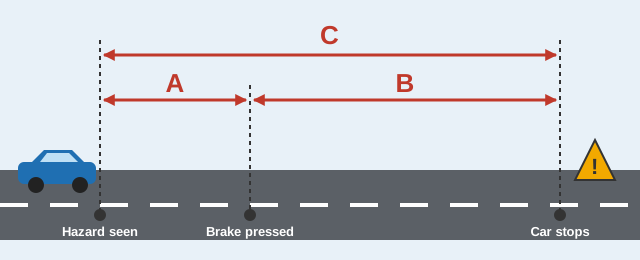
Stopping distance is the distance your car travels from the moment you notice a danger until it comes to a complete stop. It has two parts: the reaction distance, covered while you react before braking, and the braking distance, covered after you press the brake. The KSA driving handbook gives simple formulas to estimate both in metres from your speed in km/h.
The reaction distance assumes a standard reaction time of one second. The braking distance assumes hard braking on a dry road. Because braking distance grows with the square of your speed, doubling your speed makes it about four times longer (Handbook p. 16).
Stopping distance table
Reaction, braking and stopping distance by speed
Speed
Reaction
Braking
Stopping
30 km/h
9 m
9 m
18 m
40 km/h
12 m
16 m
28 m
50 km/h
15 m
25 m
40 m
60 km/h
18 m
36 m
54 m
70 km/h
21 m
49 m
70 m
80 km/h
24 m
64 m
88 m
90 km/h
27 m
81 m
108 m
100 km/h
30 m
100 m
130 m
110 km/h
33 m
121 m
154 m
120 km/h
36 m
144 m
180 m
Calculated with the handbook formulas above (Handbook p. 16).
What makes the distances longer
Speed & Stopping DistanceWhich of these makes the REACTION distance longer?
AThe vehicle is heavily loaded
BThe road is wet
CThe tires are worn
DThe driver is tired or distracted ✓(correct answer)
Correct answer: D. Tiredness or distraction slows your reaction. Wet roads, heavy loads and worn tires lengthen the braking distance instead.Source: Handbook p. 14 · View in topic
Speed & Stopping DistanceWhich of these makes the reaction distance longer?
ACarrying a heavy load
BHaving weak brakes
CDriving on a sandy road
DTaking medicine that causes drowsiness ✓(correct answer)
Correct answer: D. Drugs or medicine causing drowsiness, alcohol, tiredness, distraction and high speed lengthen reaction distance. The others affect braking distance.Source: Handbook p. 14 · View in topic
Speed & Stopping DistanceWhich factor increases BOTH the reaction distance and the braking distance?
AA wet road
BHigh speed ✓(correct answer)
CTiredness
DA heavy load
Correct answer: B. High speed is listed for both. Tiredness affects only reaction distance; a wet road and heavy load affect only braking distance.Source: Handbook p. 14 · View in topic
Speed & Stopping DistanceWhich of these makes the BRAKING distance longer?
AA tired driver
BA distracted driver
CA heavily loaded vehicle ✓(correct answer)
DA driver under the influence of alcohol
Correct answer: C. A heavy load lengthens braking distance. The other three lengthen reaction distance.Source: Handbook p. 15 · View in topic
Speed & Stopping DistanceSand, snow or a wet road surface mainly increases:
AThe driver's reaction time
BThe reaction distance
CNothing, if the tires are new
DThe braking distance ✓(correct answer)
Correct answer: D. Poor road conditions such as sand, snow or a wet surface make the braking distance longer.Source: Handbook p. 15 · View in topic
Speed & Stopping DistanceWhich vehicle condition makes the braking distance longer?
AWorking headlights
BBad tires or malfunctioning brakes ✓(correct answer)
CA full windscreen washer tank
DA clean windshield
Correct answer: B. Bad tires and malfunctioning or insufficient brakes both lengthen braking distance.Source: Handbook p. 15 · View in topic
Speed & Stopping DistanceHow can you reduce your stopping distance?
AReduce speed and increase attention ✓(correct answer)
BIncrease tire pressure above the recommended level
CFollow the vehicle ahead more closely
DBrake later but harder
Correct answer: A. The handbook lists two ways: reduce speed and increase attention.Source: Handbook p. 17 · View in topic