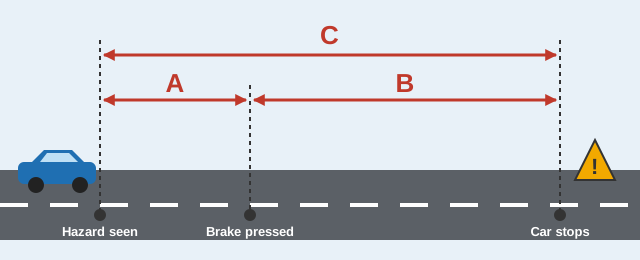
Stopping distance is reaction distance plus braking distance. The handbook uses a one-second reaction time and the formulas (speed / 10) x 3 for reaction distance and (speed / 10) x (speed / 10) for braking distance, so at 70 km/h that is 21 m plus 49 m, or 70 m. Tiredness, alcohol and drowsy medicine lengthen reaction distance; heavy loads, wet roads, sand and poor tyres or brakes lengthen braking distance. Doubling speed makes braking distance about four times longer, so adapt speed to conditions and keep your foot ready over the brake.
Question 1Why does the mix of road users (pedestrians up to 40-ton trucks) create high-risk situations?
AThey all use different fuels
BThey travel at very different speeds ✓(correct answer)
CTrucks are not allowed in cities
DPedestrians always have priority
Correct answer: B. Pedestrians move at 4-5 km/h while vehicles reach 100 km/h; this speed difference creates high-risk situations.Source: Handbook p. 11
Question 2At what speed do pedestrians typically move, according to the handbook?
AAbout 20-30 km/h
BAbout 1 km/h
CAbout 10-15 km/h
DNot exceeding 4-5 km/h ✓(correct answer)
Correct answer: D. Pedestrians move at a speed not exceeding 4-5 km/h, far below vehicles.Source: Handbook p. 11
Question 3For the human body, from roughly what speed does movement already count as 'high speed'?
A60-70 km/h
B4-5 km/h
C100 km/h
D20-30 km/h ✓(correct answer)
Correct answer: D. Humans are made to move at walking speed; high speed for us starts at 20-30 km/h.Source: Handbook p. 11
Question 4Why do drivers need the speedometer?
AHumans find it extremely difficult to estimate high speeds correctly ✓(correct answer)
BIt is only required for the practical test
CIt warns pedestrians of your speed
DIt controls the vehicle's fuel use
Correct answer: A. Since we are not built to move fast, correctly estimating higher speeds is very hard, so we need technical help from the speedometer.Source: Handbook p. 11
Question 5According to the handbook, a proper assessment of high speeds can only be made through:
AWatching the rev counter
BListening to the engine sound
CThe combined interaction of the eye and the mind ✓(correct answer)
DFollowing the car in front
Correct answer: C. Controlling high speeds needs a great deal of experience; assessing them needs the eye and mind working together.Source: Handbook p. 11
Question 6Besides speed, what other danger does the handbook highlight about driving vehicles?
AFuel is expensive
BRoads wear out quickly
CVehicles make too much noise
DWe move heavy loads (about 1,500-3,500 kg), causing serious harm in a collision ✓(correct answer)
Correct answer: D. A vehicle moves loads of 1,500-3,500 kg at high speed, which has serious consequences when hitting a vehicle or person.Source: Handbook p. 11
Question 7What is the first basic principle for choosing driving speed?
AAlways drive at exactly the posted speed limit
BSpeed must always be adapted to the surrounding conditions ✓(correct answer)
CDrive as slowly as possible at all times
DAlways keep up with the fastest traffic
Correct answer: B. The driving speed must always be adapted to the surrounding conditions.Source: Handbook p. 12
Question 8Your speed must be chosen so that:
AYou can overtake whenever you want
BYou arrive at your destination on time
CThe engine stays at low revs
DYou can stop in time to avoid a collision with an obstacle ✓(correct answer)
Correct answer: D. The second basic principle: choose a speed that lets you stop in time and avoid other sources of danger.Source: Handbook p. 12
Question 9What is the 'stopping distance'?
AThe distance from noticing danger until pressing the brake
BThe distance from pressing the brake until the vehicle stops
CThe distance from the moment the driver notices danger until the vehicle stops ✓(correct answer)
DThe gap you should keep behind the vehicle ahead
Correct answer: C. Stopping distance covers everything from becoming aware of the danger until standstill. The other two options are the braking and reaction distances.Source: Handbook p. 13
Correct answer: C. Stopping distance is the reaction (perception) distance plus the braking distance.Source: Handbook p. 13
Question 11What is the 'reaction distance'?
AThe distance travelled from realizing the danger until applying the brakes ✓(correct answer)
BThe distance travelled after applying the brakes
CThe total distance needed to stop
DThe distance between two vehicles
Correct answer: A. Reaction distance is travelled from the moment you realize the danger until you apply the brakes.Source: Handbook p. 14
Question 12What 'standard' reaction time does the handbook assume?
AFive seconds
BA tenth of a second
COne second ✓(correct answer)
DThree seconds
Correct answer: C. On average you need one second to react, so reaction distance is the distance travelled in one second.Source: Handbook p. 14
Question 13What happens to the car during the driver's reaction time?
AIt starts slowing down
BIts speed drops by half
CIt keeps moving without slowing down ✓(correct answer)
DIt stops immediately
Correct answer: C. During the reaction time the car is in motion without decelerating.Source: Handbook p. 14
Question 14Which of these makes the REACTION distance longer?
AThe vehicle is heavily loaded
BThe road is wet
CThe tires are worn
DThe driver is tired or distracted ✓(correct answer)
Correct answer: D. Tiredness or distraction slows your reaction. Wet roads, heavy loads and worn tires lengthen the braking distance instead.Source: Handbook p. 14
Question 15Which of these makes the reaction distance longer?
ACarrying a heavy load
BHaving weak brakes
CDriving on a sandy road
DTaking medicine that causes drowsiness ✓(correct answer)
Correct answer: D. Drugs or medicine causing drowsiness, alcohol, tiredness, distraction and high speed lengthen reaction distance. The others affect braking distance.Source: Handbook p. 14
Question 16Which factor increases BOTH the reaction distance and the braking distance?
AA wet road
BHigh speed ✓(correct answer)
CTiredness
DA heavy load
Correct answer: B. High speed is listed for both. Tiredness affects only reaction distance; a wet road and heavy load affect only braking distance.Source: Handbook p. 14
Question 17A driver who has consumed alcohol will have:
AA longer reaction distance ✓(correct answer)
BA shorter reaction distance
CNo change in reaction distance
DA shorter braking distance
Correct answer: A. Being under the influence of alcohol is one of the causes of a longer reaction distance.Source: Handbook p. 14
Question 18What is the 'braking distance'?
AThe distance from applying the brakes until the vehicle stops ✓(correct answer)
BThe distance from noticing danger until applying the brakes
CThe distance needed to accelerate to full speed
DThe distance from noticing danger until the vehicle stops
Correct answer: A. Braking distance starts when the brakes are applied and ends when the vehicle comes to a complete stop.Source: Handbook p. 15
Question 19Which of these makes the BRAKING distance longer?
AA tired driver
BA distracted driver
CA heavily loaded vehicle ✓(correct answer)
DA driver under the influence of alcohol
Correct answer: C. A heavy load lengthens braking distance. The other three lengthen reaction distance.Source: Handbook p. 15
Question 20Sand, snow or a wet road surface mainly increases:
AThe driver's reaction time
BThe reaction distance
CNothing, if the tires are new
DThe braking distance ✓(correct answer)
Correct answer: D. Poor road conditions such as sand, snow or a wet surface make the braking distance longer.Source: Handbook p. 15
Question 21Which vehicle condition makes the braking distance longer?
AWorking headlights
BBad tires or malfunctioning brakes ✓(correct answer)
CA full windscreen washer tank
DA clean windshield
Correct answer: B. Bad tires and malfunctioning or insufficient brakes both lengthen braking distance.Source: Handbook p. 15
Question 22Compared with normal strong braking on a dry road, braking as hard as possible (emergency braking) can make the braking distance:
ALonger
BExactly the same
CTwice as long
DShorter ✓(correct answer)
Correct answer: D. The handbook notes the distance may become shorter if you brake as hard as possible.Source: Handbook p. 15
Question 23How does a slippery road affect braking distance?
AIt makes it longer ✓(correct answer)
BIt has no effect
CIt only affects reaction distance
DIt makes it shorter
Correct answer: A. The braking distance will be longer if the road is slippery.Source: Handbook p. 15
Question 24Which formula gives the reaction distance in metres (reaction time 1 second)?
A(Speed / 10) x 3 ✓(correct answer)
BSpeed / 3
C(Speed / 10) x (Speed / 10)
DSpeed x 3
Correct answer: A. Reaction distance = (speed / 10) x 3. For example, 50 km/h gives 5 x 3 = 15 m.Source: Handbook p. 16
Question 25Which formula gives the braking distance in metres (hard braking, dry road)?
ASpeed x 2
B(Speed / 10) x (Speed / 10) ✓(correct answer)
CSpeed / 2
D(Speed / 10) x 3
Correct answer: B. Braking distance = (speed / 10) squared. For example, 80 km/h gives 8 x 8 = 64 m.Source: Handbook p. 16
Question 26Using the handbook's formula, what is the reaction distance at 70 km/h?
A21 m ✓(correct answer)
B70 m
C49 m
D7 m
Correct answer: A. (70 / 10) x 3 = 7 x 3 = 21 m.Source: Handbook p. 16
Question 27Using the handbook's formula, what is the braking distance at 70 km/h?
A70 m
B21 m
C49 m ✓(correct answer)
D14 m
Correct answer: C. (70 / 10) x (70 / 10) = 7 x 7 = 49 m.Source: Handbook p. 16
Question 28Using the handbook's formulas, what is the total stopping distance at 70 km/h?
A70 m ✓(correct answer)
B140 m
C91 m
D49 m
Correct answer: A. Reaction 21 m + braking 49 m = 70 m.Source: Handbook p. 16
Question 29According to the handbook's table, what is the stopping distance at 50 km/h?
A50 m
B40 m ✓(correct answer)
C15 m
D25 m
Correct answer: B. At 50 km/h: reaction 15 m + braking 25 m = 40 m.Source: Handbook p. 16
Question 30According to the handbook's table, what is the braking distance at 100 km/h?
A30 m
B100 m ✓(correct answer)
C50 m
D130 m
Correct answer: B. At 100 km/h: reaction 30 m, braking 100 m, stopping 130 m.Source: Handbook p. 16
Question 31According to the handbook's table, what is the stopping distance at 120 km/h?
A120 m
B36 m
C180 m ✓(correct answer)
D144 m
Correct answer: C. At 120 km/h: reaction 36 m + braking 144 m = 180 m.Source: Handbook p. 16
Question 32According to the handbook's table, what is the reaction distance at 30 km/h?
A30 m
B18 m
C9 m ✓(correct answer)
D3 m
Correct answer: C. At 30 km/h: reaction 9 m, braking 9 m, stopping 18 m.Source: Handbook p. 16
Question 33According to the handbook's table, what is the stopping distance at 80 km/h?
A64 m
B80 m
C24 m
D88 m ✓(correct answer)
Correct answer: D. At 80 km/h: reaction 24 m + braking 64 m = 88 m.Source: Handbook p. 16
Question 34If you double your speed from 50 km/h to 100 km/h, the braking distance becomes about:
AThree times longer (25 m to 75 m)
BFour times longer (25 m to 100 m) ✓(correct answer)
CThe same
DTwice as long (25 m to 50 m)
Correct answer: B. Braking distance grows with the square of speed: (5x5)=25 m becomes (10x10)=100 m.Source: Handbook p. 16
Question 35In the diagram, which distance does the arrow marked A show?
AReaction distance ✓(correct answer)
BStopping distance
CBraking distance
DSafety distance to the car ahead
Correct answer: A. A runs from the moment the hazard is seen to the moment the brake is pressed: the reaction distance.Source: Handbook p. 13
Question 36In the diagram, which distance does the arrow marked C show?
AReaction distance
BStopping distance (A + B) ✓(correct answer)
CBraking distance
DOvertaking distance
Correct answer: B. C spans from hazard detected to standstill, so it is the stopping distance = reaction (A) + braking (B).Source: Handbook p. 13
Question 37How can you reduce your stopping distance?
AReduce speed and increase attention ✓(correct answer)
BIncrease tire pressure above the recommended level
CFollow the vehicle ahead more closely
DBrake later but harder
Correct answer: A. The handbook lists two ways: reduce speed and increase attention.Source: Handbook p. 17
Question 38You see a situation ahead where you might need to brake. What does the handbook advise?
AShift into neutral
BSound the horn continuously
CPut your foot on the brake pedal without pressing it ✓(correct answer)
DPump the brakes several times
Correct answer: C. Being prepared to brake means covering the brake pedal without pressing it, which shortens your reaction time.Source: Handbook p. 17
Question 39According to the handbook, what is the cause of many traffic accidents?
AKeeping a large following distance
BUsing headlights during the day
CSpeed and/or not adapting speed to road and traffic conditions ✓(correct answer)
DDriving in the right lane
Correct answer: C. Speed and/or failing to adapt speed to the road and traffic situation causes many accidents.Source: Handbook p. 17