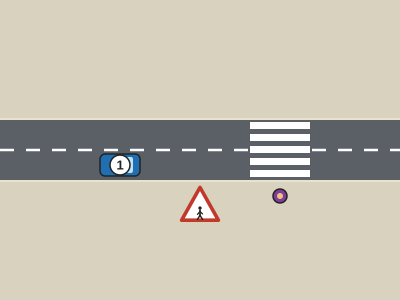
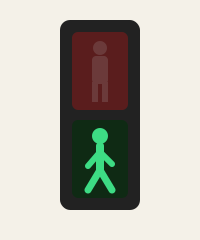
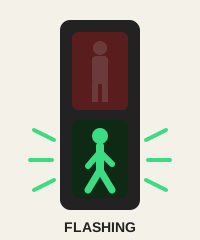
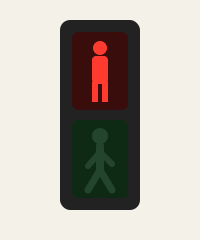
This topic introduces the parts of a road and the vocabulary used throughout the handbook. You will learn what the carriageway, highway, service road, merge lane, traffic island and open road are, and what counts as an intersection. It also covers sidewalks, bicycle lanes and pedestrian crossings, including how pedestrian signals work: steady green means they may cross, flashing green means those who have not started should wait, and red means do not cross. Drivers must slow down and stop for pedestrians at unsignalled crossings.
Question 1What is the road (carriageway) intended for?
AParking only
BThe movement of vehicles ✓(correct answer)
CPedestrian walking
DHolding public events
Correct answer: B. The road is intended for vehicle movement; it may have several lanes marked on its surface. Pedestrians use the sidewalk.Source: Handbook p. 39
Question 2How can you tell where the lanes of a multi-lane road are?
AFrom the colour of the kerb
BLanes are never marked
CFrom the street lights
DFrom the markings on the road surface ✓(correct answer)
Correct answer: D. A road may contain several lanes, and their features are marked on the road surface.Source: Handbook p. 39
Question 3Which description fits a highway?
AIt is a narrow road inside a residential neighbourhood
BIt is entered and exited through entrances and exits and does not directly serve properties ✓(correct answer)
CIt is a lane reserved for pedestrians
DIt gives direct access to houses and shops along it
Correct answer: B. A highway is accessed through entrances and exits and does not directly serve real estate.Source: Handbook p. 39
Question 4What is a service road?
AA road accessed only through exits
BA road used only by emergency vehicles
CA lane for joining the motorway
DA road that directly serves the neighbouring properties ✓(correct answer)
Correct answer: D. The service road directly serves neighbouring properties, unlike a highway.Source: Handbook p. 39
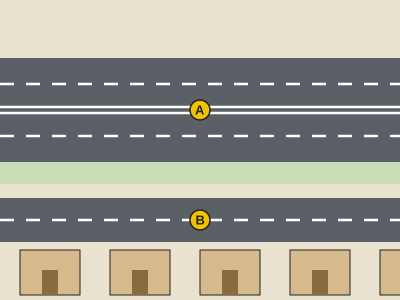
Question 5In the picture, which road is the service road?
ARoad B, next to the buildings ✓(correct answer)
BBoth roads
CNeither road
DRoad A, the divided main road
Correct answer: A. Road B gives direct access to the buildings, so it is the service road. Road A is the main road that doesn't serve properties directly.Source: Handbook p. 39
Question 6What does the handbook mean by the 'open town' (open road)?
AThe road network outside cities and towns ✓(correct answer)
BA road with no speed limit
CA pedestrian zone in the city centre
DA residential area inside the city
Correct answer: A. A residential area lies within the city; the open town is the road network outside cities and towns.Source: Handbook p. 40
Question 7Where is a residential area located?
AWithin the city ✓(correct answer)
BOutside cities and towns
COnly on highways
DOnly next to industrial zones
Correct answer: A. A residential area is a geographic area within the city; the road network outside cities is the open town.Source: Handbook p. 40
Question 8What is a traffic island?
AA parking area in the middle of a roundabout
BA lane for slow vehicles
CA bus stop on the side of the road
DA small raised area that separates traffic moving in two different directions ✓(correct answer)
Correct answer: D. The traffic island is a small, elevated area dividing traffic into two different directions.Source: Handbook p. 40
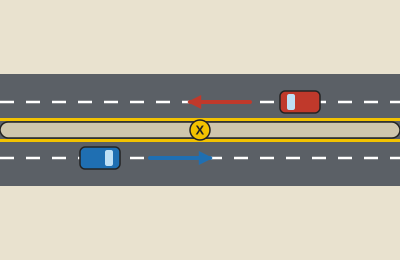
Question 9What is the raised area marked X in the picture called?
AA service road
BA merge lane
CA traffic island ✓(correct answer)
DA pedestrian crossing
Correct answer: C. A small raised area separating the two directions of traffic is a traffic island.Source: Handbook p. 40
Question 10What is a merge lane?
AA lane for parking
BA lane reserved for buses
CA lane for overtaking only
DA lane that allows traffic to join a regular road or motorway ✓(correct answer)
Correct answer: D. A merge lane lets traffic be incorporated into a regular road or motorway.Source: Handbook p. 40
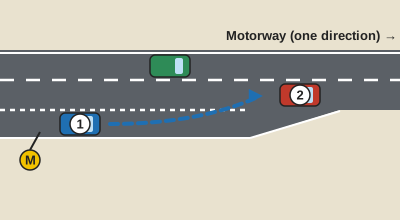
Question 11Car 1 is in lane M, which ends as it joins the motorway. What is lane M called?
AA service road
BA merge lane ✓(correct answer)
CA traffic island
DAn emergency lane
Correct answer: B. A lane that lets traffic join a regular road or motorway is a merge lane.Source: Handbook p. 40
Question 12Which of these counts as an 'intersection' in the handbook?
AOnly roundabouts
BAny crossing, junction or branching of roads, on one or more levels, including the area it forms ✓(correct answer)
COnly roads that cross at exactly 90 degrees
DOnly crossings that have traffic lights
Correct answer: B. The term covers any intersection, crossing or branching of roads on one or more levels, including the area formed.Source: Handbook p. 41
Question 13Which of the following is NOT a way a controlled intersection is regulated?
ABy a traffic officer
BBy traffic lights
CBy the driver who arrives first ✓(correct answer)
DBy road signs
Correct answer: C. Controlled intersections are regulated by light signals, road signs, or a traffic officer.Source: Handbook p. 41
Question 14An intersection has no signs, markings, lights or traffic officer. What governs who goes first?
Correct answer: B. Uncontrolled intersections are without any marks and are governed by the priority rules.Source: Handbook p. 41
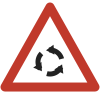
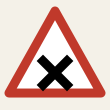
Question 15What does this sign warn you about?
AA roundabout ahead ✓(correct answer)
BA recycling area
CA mandatory roundabout direction you must follow now
DA U-turn ahead
Correct answer: A. A red-framed triangle is a warning sign; the circular arrows mean a roundabout ahead.Source: Handbook p. 41
Question 16What does this sign warn you about?
ARoad closed
BA railway crossing
CA crossroads (intersection) ahead ✓(correct answer)
DHospital ahead
Correct answer: C. The black X in a red-framed triangle warns of a crossroads ahead.Source: Handbook p. 41
Question 17 · extraHow is a bicycle lane indicated?
ABy a brown rectangular sign
BBy a yellow square sign
CBy a red triangle showing a bicycle
DBy a blue round mandatory sign showing a bicycle ✓(correct answer)
Correct answer: D. A bicycle lane is marked with a mandatory (blue, circular) sign for cyclists.Source: Handbook p. 42
Question 18Who is the sidewalk (pedestrian path) intended for?
ACyclists and cars
BMotorbikes only
CVehicles that are parking
DPedestrians, not vehicles ✓(correct answer)
Correct answer: D. The sidewalk is part of the road intended for pedestrian use and not for vehicles.Source: Handbook p. 42
Question 19What is a pedestrian crossing?
AA lane where pedestrians walk along the road
BA specific part of the road that pedestrians are entitled to cross ✓(correct answer)
CA bridge for vehicles over a footpath
DAny place where a pedestrian decides to cross
Correct answer: B. A pedestrian crossing is a specific part of the road pedestrians are entitled to cross. It may have white markings and traffic lights.Source: Handbook p. 42
Question 20How may a pedestrian crossing be marked?
AWith red painted circles
BWith white markings on the road ✓(correct answer)
CIt is never marked
DWith yellow zigzag lines only
Correct answer: B. Pedestrian crossings may be marked with white road markings and can also be controlled by traffic lights.Source: Handbook p. 42
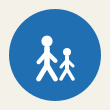
Question 21What does this sign mean?
ASidewalk / path for pedestrians only (mandatory) ✓(correct answer)
BWarning: children crossing ahead
CPedestrians prohibited
DSchool zone ends
Correct answer: A. A blue circular sign is mandatory: this one indicates a pedestrian path. Don't confuse it with the red triangle warning of children crossing.Source: Handbook p. 42
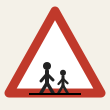
Question 22What does this sign mean?
AWarning: children crossing ahead ✓(correct answer)
BPlayground: no vehicles
CPedestrian path only (mandatory)
DPedestrians prohibited
Correct answer: A. A red-framed triangle is a warning sign; this one warns of children crossing. The blue circle with figures is the mandatory pedestrian path.Source: Handbook p. 42
Question 23A blue round sign and a red-framed triangle both show walking figures. What is the difference?
AThe blue circle marks a mandatory pedestrian path; the triangle warns of children crossing ✓(correct answer)
BThe blue circle bans pedestrians; the triangle allows them
CBoth mean exactly the same thing
DThe blue circle warns of children; the triangle marks a pedestrian path
Correct answer: A. The handbook stresses never confusing these two: blue circle = mandatory pedestrian path, red triangle = children crossing warning.Source: Handbook p. 42
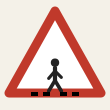
Question 24What does this sign warn you about?
AA bus stop ahead
BA pedestrian path only
CA pedestrian crossing ahead ✓(correct answer)
DNo pedestrians allowed
Correct answer: C. This red-framed warning triangle shows a pedestrian on a crossing: a pedestrian crossing is ahead.Source: Handbook p. 42
Question 25You approach a pedestrian crossing with no traffic lights and no traffic officer. A pedestrian wants to cross. What must you do?
ASlow down and stop in front of the crossing to let them cross ✓(correct answer)
BSpeed up to pass before they step out
CSound the horn so the pedestrian waits
DKeep your speed; pedestrians must wait for a gap
Correct answer: A. At crossings without lights or an officer, drivers must slow down to stop in front of the crossing if pedestrians want to cross.Source: Handbook p. 43
Question 26When approaching an unsignalled pedestrian crossing, what should your speed allow you to do?
APass the crossing before anyone steps out
BStop in front of the crossing if a pedestrian wants to cross ✓(correct answer)
CBrake only after reaching the crossing
DOvertake the car ahead on the crossing
Correct answer: B. Slow down in time so you can stop before the crossing; the safety of pedestrians must not be endangered.Source: Handbook p. 43
Question 27The pedestrian signal shows a steady green figure. What does it mean for pedestrians?
AThey must run across immediately
BThey may cross but should still watch the traffic ✓(correct answer)
CVehicles have priority on the crossing
DThey must not start crossing
Correct answer: B. A continuous green light allows pedestrians to cross, but they need to monitor traffic.Source: Handbook p. 44
Question 28The pedestrian signal is flashing green. What should a pedestrian who has NOT yet stepped onto the crossing do?
ACross slowly
BStart crossing quickly
CWait and not enter the crossing ✓(correct answer)
DCross only if no car is visible
Correct answer: C. Flashing green means the signal will soon turn red: those already crossing should speed up, those approaching must wait.Source: Handbook p. 44
Question 29A pedestrian is halfway across when the signal starts flashing green. What should they do?
AContinue at a slow pace
BGo back to where they started
CSpeed up to finish crossing ✓(correct answer)
DStop in the middle of the road
Correct answer: C. Flashing green warns that red is coming soon, so pedestrians already crossing must speed up.Source: Handbook p. 44
Question 30What does a red pedestrian signal mean for pedestrians?
AThey may cross carefully
BOnly children may cross
CThey should cross quickly
DThey must not cross ✓(correct answer)
Correct answer: D. Pedestrians are not allowed to cross on a red (or orange) signal.Source: Handbook p. 44
Question 31At a pedestrian crossing outside an intersection that has flashing yellow lights, who has priority?
APedestrians, though they must still watch traffic carefully ✓(correct answer)
BWhoever is faster
CNobody; the crossing is closed
DVehicles always
Correct answer: A. At such crossings pedestrians have priority to cross, but must watch traffic carefully, especially where drivers may drive fast.Source: Handbook p. 44
Question 32According to the handbook, about how many times heavier is a car than a pedestrian?
A5 times
B10 times
C100 times
D25 times ✓(correct answer)
Correct answer: D. A car weighs about 25 times the weight of a pedestrian, so always be careful and watch traffic.Source: Handbook p. 44