Passing a stationary obstacle, such as a broken-down car, roadworks or a standing herd of animals, is treated like a lane change. Look, evaluate, decide and act: check the interior and left mirrors, signal left, check the left blind spot, slow down if the gap is narrow and leave enough side distance. If traffic is coming from the opposite direction, wait behind the obstacle and let it pass first. Do not pass if it would endanger others, or while people are boarding a stopped tram. When passing parked cars at 50 km/h keep about one metre.
Correct answer: D. The handbook says passing an obstacle is similar to changing course: mirrors, signal, shoulder check, speed, move.Source: Handbook p. 192
Question 6There is an obstacle in your path. What is the correct order of thinking?
AEvaluate, act, look, decide
BLook, evaluate, decide, act ✓(correct answer)
CDecide, act, look, evaluate
DAct, look, decide, evaluate
Correct answer: B. Look (what happened?), Evaluate (oncoming traffic, enough space?), Decide (pass or stop), Act (move or stop).Source: Handbook p. 193
Question 7At the 'Evaluate' step when you meet an obstacle in your path, what do you check?
AWhether you can pass it without signalling
BWhether traffic is coming and whether there is enough space to pass ✓(correct answer)
CHow much time you will lose
DWho owns the obstacle
Correct answer: B. Evaluate: is there a movement coming? Is there enough space for passage?Source: Handbook p. 193
Question 8After evaluating an obstacle in your path, what are the two possible decisions?
APass it or stop ✓(correct answer)
BOvertake on the right or on the left
CReverse or turn around
DSound the horn or flash the lights
Correct answer: A. Decide: decide to either pass or stop; then act on that decision.Source: Handbook p. 193
Question 9Before driving around an obstacle, which mirrors should you check?
ANo mirrors; just look ahead
BOnly the right side mirror
CThe interior mirror and the left side mirror ✓(correct answer)
DOnly the interior mirror
Correct answer: C. Check the interior and left side mirrors for vehicles behind that may be about to overtake.Source: Handbook p. 193
Question 10Which signal should you give before moving out around an obstacle in your lane?
AA right signal
BHazard warning lights only
CNo signal is needed
DA left signal ✓(correct answer)
Correct answer: D. Signal: give a left signal, because you are moving to the left to pass.Source: Handbook p. 193
Question 11Which blind spot should you check before moving out to pass an obstacle?
AThe blind spot on the left side of your vehicle ✓(correct answer)
BThe blind spot on the right side
CNo blind spot check is needed for a stationary obstacle
DThe area directly in front of the bonnet
Correct answer: A. Shoulder: check the blind spot on the left side, the side you are moving into.Source: Handbook p. 193
Question 12The gap beside an obstacle in your lane is narrow. How should you adjust your speed?
ASlow down ✓(correct answer)
BSpeed up to get past quickly
CStop and switch off the engine
DKeep exactly the same speed
Correct answer: A. Adapt the speed: speed up if the obstacle can be passed quickly, slow down if the gap is narrow.Source: Handbook p. 193
Question 13When moving around an obstacle, what must you make sure of?
AThat you sound the horn throughout
BThat there is enough sideways distance from the obstacle, and that you drive smoothly ✓(correct answer)
CThat you pass as close to the obstacle as possible
DThat you keep your right wheels on the shoulder
Correct answer: B. Move to the left, make sure there is enough sideways distance, and drive smoothly.Source: Handbook p. 193
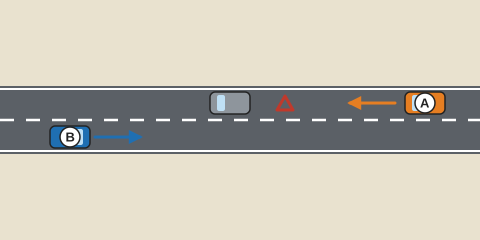
Question 14A broken-down car (with a warning triangle) blocks car A's lane. Car B is coming from the opposite direction. Who goes first?
AWhichever car is faster
BCar A, because it reached the obstacle first
CCar B, because its side of the road is open ✓(correct answer)
DCar A, because it is on the left
Correct answer: C. The driver whose road is open has the right of way. A has the obstacle in its lane and must wait for B.Source: Handbook p. 194
Question 15There is an obstacle in YOUR lane and a car is approaching in the other lane. What should you do?
ASound the horn and drive around
BWait behind the obstacle and let the oncoming car pass first ✓(correct answer)
CMove out quickly before it arrives
DFlash your lights so it stops for you
Correct answer: B. The driver whose lane is free has priority. With the obstacle in your lane, you give way.Source: Handbook p. 194
Question 16When driving past parked vehicles at 50 km/h, roughly what side distance should you keep?
ANo gap is needed
BAbout 20 centimetres
CAbout one metre ✓(correct answer)
DAbout three metres
Correct answer: C. At 50 km/h one metre is a safe side distance, roughly the space needed to open a vehicle door.Source: Handbook p. 195
Question 17Why is about one metre recommended when passing parked cars at 50 km/h?
AIt is required only for trucks
BIt is the length of a bicycle
CIt is roughly the space needed for a car door to open ✓(correct answer)
DIt is the width of a lane marking
Correct answer: C. One metre approximates the space needed to open the vehicle door.Source: Handbook p. 195
Question 18How does your speed affect the side distance you need when passing parked vehicles?
AThe faster you drive, the smaller the distance can be
BSpeed has no effect on side distance
CThe faster you drive, the greater the side distance must be ✓(correct answer)
DSide distance only matters at night
Correct answer: C. The required lateral distance depends on driving speed: faster means a greater distance.Source: Handbook p. 195
Question 19You are passing a row of parked cars on a two-way road and a car is coming the other way with no room for both. What may you have to do?
ASlow down or stop to let the oncoming car through ✓(correct answer)
BSpeed up to pass first
CSound the horn and continue
DDrive onto the sidewalk
Correct answer: A. On a two-way road you may have to slow down or stop when traffic comes from the other direction.Source: Handbook p. 195
Question 20What extra hazard should you watch for when driving past parked vehicles?
ATheir alarms going off
BDirt on their number plates
CTheir headlights dazzling you
DVehicles that are about to pull out ✓(correct answer)
Correct answer: D. Pay attention and be careful of vehicles that are about to move.Source: Handbook p. 195