Knowing when not to overtake matters as much as knowing how. Overtaking is prohibited at intersections, pedestrian crossings and railway crossings, on bridges, on curves and hill crests where you cannot see ahead, on slippery roads and when visibility is poor because of fog or dust. It is also banned across a solid centre line, when a vehicle is approaching from the opposite direction, when the vehicle ahead is already overtaking or someone behind has begun to overtake you, and when it would require exceeding the speed limit. If in doubt, do not overtake.
Question 1Is overtaking allowed at an intersection?
AYes, if you sound your horn first
BYes, if no vehicles are waiting
CNo, overtaking is prohibited at intersections ✓(correct answer)
DYes, if the light is green
Correct answer: C. Overtaking is prohibited at intersections and at railway crossings.Source: Handbook p. 198
Question 2Is overtaking allowed at a railway crossing?
AYes, if the barriers are up
BYes, if no train is visible
CYes, at low speed
DNo, never ✓(correct answer)
Correct answer: D. Overtaking is prohibited at railway crossings.Source: Handbook p. 198
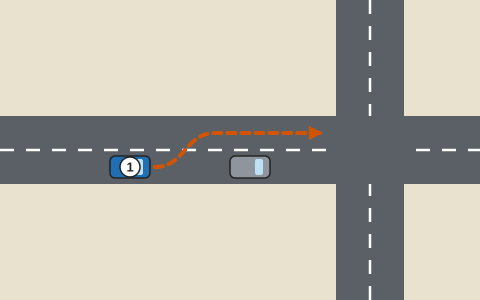
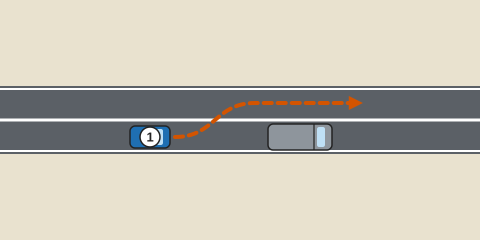
Question 3May car 1 overtake the car ahead here?
AYes, if it signals left first
BNo, overtaking is prohibited at intersections ✓(correct answer)
CYes, if it speeds up enough
DYes, the centre line is dashed
Correct answer: B. Even with a dashed centre line, overtaking at intersections is prohibited.Source: Handbook p. 198
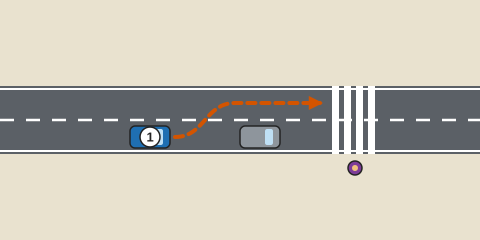
Question 4May car 1 overtake the car ahead here?
AYes, because the centre line is dashed
BNo, overtaking at pedestrian crossings is prohibited ✓(correct answer)
CYes, if it sounds the horn
DYes, if no pedestrian is on the crossing yet
Correct answer: B. Overtaking is prohibited at pedestrian crossings. The car in front may be hiding a pedestrian.Source: Handbook p. 198
Question 5Is overtaking permitted on a bridge?
AYes, on the right side
BYes, during daytime
CYes, if the bridge has two lanes
DNo, overtaking on bridges is prohibited ✓(correct answer)
Correct answer: D. Overtaking is prohibited on bridges.Source: Handbook p. 199
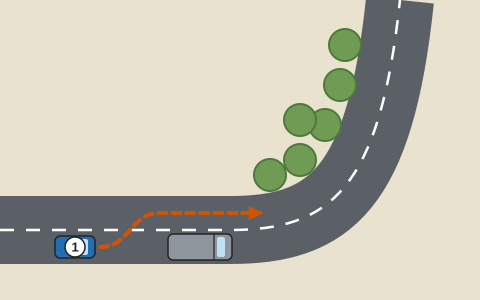
Question 6May car 1 overtake the truck here?
ANo, overtaking is prohibited on curves where the road ahead cannot be seen ✓(correct answer)
BYes, if it accelerates hard
CYes, the centre line is dashed
DYes, if the truck is slow
Correct answer: A. Overtaking is prohibited on curved roads and dangerous curves.Source: Handbook p. 199
Question 7Where is overtaking prohibited?
AOn roads with more than two lanes per direction
BOn long straight roads with good visibility
COn curved roads and dangerous curves ✓(correct answer)
DOn roads with a dashed centre line
Correct answer: C. Curves are on the list of places where overtaking is prohibited.Source: Handbook p. 199
Question 8The road is slippery after rain. Is overtaking allowed?
AYes, if you use your headlights
BNo, overtaking on slippery roads is prohibited ✓(correct answer)
CYes, if you accelerate quickly
DYes, on the right
Correct answer: B. Overtaking is prohibited on slippery roads.Source: Handbook p. 199
Question 9You are approaching the top of a hill and cannot see the road beyond it. May you overtake?
AYes, if the centre line is dashed
BYes, if the vehicle ahead is slow
CNo, overtaking where you cannot see the road ahead over a hill is prohibited ✓(correct answer)
DYes, if you sound the horn first
Correct answer: C. Overtaking is prohibited at hills and crests, where oncoming traffic cannot be seen.Source: Handbook p. 200
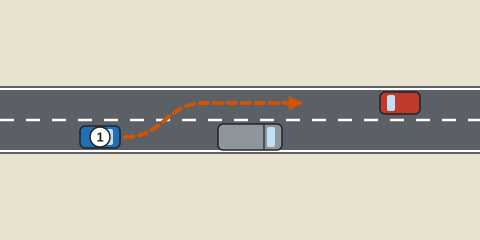
Question 10May car 1 overtake the truck now?
AYes, if it flashes its headlights
BNo, a vehicle is coming from the opposite direction ✓(correct answer)
CYes, the centre line is dashed
DYes, if it moves back quickly
Correct answer: B. Overtaking is prohibited when vehicles are coming the other way; you must not obstruct oncoming traffic.Source: Handbook p. 200
Question 11Visibility is poor because of fog or a dust storm. Is overtaking allowed?
AYes, with fog lights on
BYes, on straight roads
CYes, if you sound the horn
DNo, overtaking is prohibited when visibility is insufficient ✓(correct answer)
Correct answer: D. Overtaking is prohibited where visibility on the roads is insufficient or weak.Source: Handbook p. 201
Question 12What does this sign mean?
ACar park
BNo overtaking ✓(correct answer)
CKeep a safe distance
DTwo-way traffic
Correct answer: B. The red circle with two cars side by side means overtaking is prohibited.Source: Handbook p. 202
Question 13May car 1 overtake the truck here?
AYes, if the road ahead is clear
BNo, crossing the solid centre line to overtake is prohibited ✓(correct answer)
CYes, because the truck is slow
DYes, if it returns to its lane quickly
Correct answer: B. Overtaking is prohibited where there are solid lines between the lanes.Source: Handbook p. 202
Question 14The line between your lane and the oncoming lane is solid. What does that mean for overtaking?
AOvertaking across it is prohibited ✓(correct answer)
BOvertaking is allowed during daytime only
COvertaking is allowed if it is safe
DOvertaking is allowed for cars but not trucks
Correct answer: A. Solid lines between the lanes mean no overtaking.Source: Handbook p. 202
Question 15The vehicle in front drives at 95 km/h on a road limited to 100 km/h. Should you overtake it?
AYes, at 100 km/h, however long it takes
BYes, at 120 km/h for a short time
CNo, you cannot drive significantly faster without exceeding the limit ✓(correct answer)
DYes, if you flash your lights first
Correct answer: C. Overtaking is prohibited if you can't drive significantly faster than the vehicle in front, or if you'd exceed the speed limit.Source: Handbook p. 203
Question 16Is it allowed to exceed the speed limit briefly to complete an overtake?
AYes, for up to 10 seconds
BNo, overtaking is prohibited if it requires exceeding the speed limit ✓(correct answer)
CYes, on highways
DYes, by up to 20 km/h
Correct answer: B. Overtaking is prohibited if the speed limit would be exceeded.Source: Handbook p. 203
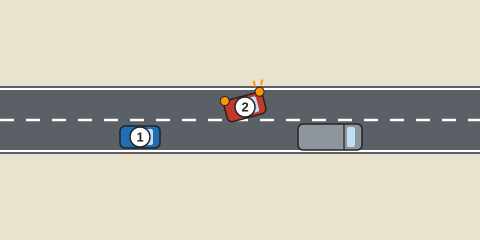
Question 17Car 2 in front of you has already started to overtake the truck. May car 1 overtake too?
AYes, if car 1 is faster
BYes, by following close behind car 2
CYes, on the right side of the truck
DNo, not while the vehicle in front is overtaking ✓(correct answer)
Correct answer: D. Overtaking is prohibited if the vehicle in front begins to overtake another vehicle.Source: Handbook p. 203
Question 18You want to overtake, but your mirror shows a car behind you has already started overtaking you. What should you do?
ADo not overtake; stay in your lane ✓(correct answer)
BSpeed up to stay ahead
CBrake hard to let it pass
DMove out quickly in front of it
Correct answer: A. Overtaking is prohibited if a vehicle behind you has begun to overtake you.Source: Handbook p. 203
Question 19You are not sure whether it is safe to overtake. What does the handbook advise?
ADo not try to overtake if you are in doubt ✓(correct answer)
BOvertake quickly to reduce risk
COvertake on the right instead
DOvertake while sounding the horn
Correct answer: A. Many things must be considered when overtaking, so do not try to overtake if you are in doubt.Source: Handbook p. 203