This topic covers vehicles that receive special treatment on the road. Emergency vehicles on a mission, identified by red and blue lights and sirens, have the highest priority, and you should move to the right to let them pass or clear an intersection quickly. You must keep at least 50 metres behind them. School buses carry school-transport markings, open their doors only after stopping completely, and students use the right side. Overtaking a stopped school bus is prohibited. Official processions with sound and light warnings must be given way and never obstructed.
Question 1Which road users have the right of priority as emergency vehicles?
AVehicles such as public security and ambulances ✓(correct answer)
BTrucks carrying goods
CTaxis and buses
DAny vehicle using hazard lights
Correct answer: A. Emergency vehicles such as public security and ambulances have the right of priority.Source: Handbook p. 77
Question 2An emergency vehicle on an emergency mission has:
AThe highest priority; it is not bound by regulations but must not endanger anyone ✓(correct answer)
BPriority only at traffic lights
CPriority only on highways
DThe same priority as other vehicles
Correct answer: A. Emergency vehicles on emergency missions have the highest priority and aren't bound by regulations or prohibitions, but must not endanger their own or others' safety.Source: Handbook p. 78
Question 3An ambulance on an emergency call passes through a red light. Is this allowed?
AOnly between midnight and 6 a.m.
BOnly if a police car escorts it
CYes, emergency drivers are not bound by the rules in an emergency, as long as they don't endanger others ✓(correct answer)
DNo, all vehicles must obey red lights
Correct answer: C. In an emergency, emergency vehicle drivers are not bound by regulations or prohibitions, but must not endanger themselves or others.Source: Handbook p. 78
Question 4How can you identify an emergency vehicle on an emergency mission?
ABy its red and blue lights and its sound warning signals ✓(correct answer)
BBy its high speed only
CBy its hazard lights only
DBy a white flag
Correct answer: A. Emergency vehicles use visual warning signals (red and blue lights) and sound warning signals.Source: Handbook p. 78
Question 5What is the minimum distance you must keep behind an emergency vehicle?
A100 metres
B50 metres ✓(correct answer)
C10 metres
D20 metres
Correct answer: B. It is prohibited to drive directly behind emergency vehicles; a distance of at least 50 m must be kept.Source: Handbook p. 78
Question 6An ambulance with its siren on overtakes you and clears the traffic ahead. Can you follow closely behind it to move faster?
AYes, if you also switch on your hazard lights
BYes, but only on highways
CYes, it is the safest gap in traffic
DNo, driving directly behind it is prohibited; keep at least 50 m ✓(correct answer)
Correct answer: D. Driving directly behind emergency vehicles is prohibited; keep at least 50 metres.Source: Handbook p. 78
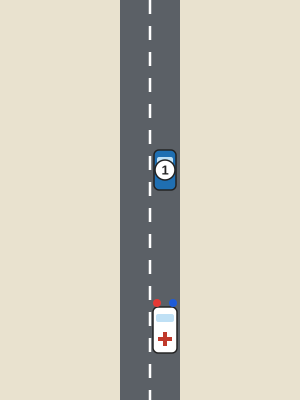
Question 7You (car 1) hear a siren and see an ambulance with flashing lights behind you. What should you do?
AMove to the left so it passes on your right
BAccelerate to stay ahead of it
CStop immediately in the middle of the lane
DKeep or move to the right side of the road to let it pass ✓(correct answer)
Correct answer: D. Drivers must stay on the right side of the road and make way when an emergency vehicle approaches.Source: Handbook p. 78
Question 8You are inside an intersection when you hear an approaching emergency vehicle. What should you do?
ATurn off your engine
BStop inside the intersection and wait
CClear the intersection quickly so you don't block it ✓(correct answer)
DReverse back to the stop line
Correct answer: C. Intersections must be cleared quickly so as not to obstruct emergency vehicles approaching them.Source: Handbook p. 78
Question 9What must school buses carry?
AMarkings showing they are intended for school transport ✓(correct answer)
BA flashing green light on the roof
CA sign showing the number of students
DA police escort
Correct answer: A. School buses must bear markings indicating that they are intended for school transportation.Source: Handbook p. 79
Question 10When may the doors of a school bus be opened?
AWhenever a student asks
BOnly after the bus has stopped completely ✓(correct answer)
CBefore arriving, to save time
DAs soon as the bus slows down near the station
Correct answer: B. School buses must stop at specific stations, and doors must not open until the bus has stopped completely.Source: Handbook p. 79
Question 11From which side should students get on and off a school bus?
AEither side
BThe rear door only
CThe right side, from the sidewalk ✓(correct answer)
DThe left side, from the road
Correct answer: C. Students must enter from the right side (from the sidewalk).Source: Handbook p. 79
Question 12When may the school bus driver move off from a stop?
AOnly after making sure the students are safe ✓(correct answer)
BAfter a fixed 30 seconds
CAs soon as the doors close
DWhen the next bus arrives
Correct answer: A. The school bus driver should only drive after making sure that students are safe.Source: Handbook p. 79
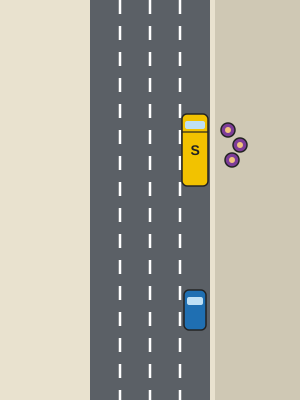
Question 13You are the blue car. The school bus ahead has stopped and students are getting off. What must you do?
AOvertake only if no students are on the road
BStop and wait; do not overtake the bus ✓(correct answer)
COvertake it carefully in the left lane
DSound the horn and pass
Correct answer: B. Other vehicles must stop and are prohibited from overtaking school buses when they stop to load or unload students.Source: Handbook p. 79
Question 14Is it allowed to overtake a school bus that has stopped to let students on or off?
ANo, it is prohibited ✓(correct answer)
BYes, if you use your turn signal
CYes, on multi-lane roads
DYes, at low speed
Correct answer: A. Overtaking school buses stopped to load or unload students is prohibited (and carries 4 points).Source: Handbook p. 79
Question 15An official procession announces its approach with sound and light warning devices. What should you do?
AStop in the middle of the road
BGive way, keep to the right side of the road, and move off only after it has passed or as instructed ✓(correct answer)
CJoin the procession
DSpeed up to get ahead of it
Correct answer: B. Road users give way to official processions once they announce their approach, keep to the right, and don't move off until it has passed or according to instructions.Source: Handbook p. 80
Question 16Which behaviour toward an official procession is prohibited?
AWaiting until it has passed
BPulling over to the right
CFollowing police instructions
DInterrupting it or obstructing its movement ✓(correct answer)
Correct answer: D. Official processions must not be interrupted or have their movement obstructed by other road users.Source: Handbook p. 80