This topic is about sharing the road responsibly. It starts with the principles of driving safely, legally and with respect, meaning you drive only when fit and licensed, obey the law and lights, and respect the rights of others. Questions then cover pedestrians: use the sidewalk or walk facing traffic, cross quickly after judging vehicle speed, and follow pedestrian lights. Drivers must stop for pedestrians already crossing and when turning into a road with people crossing. Groups walking on public roads must wear reflective vests, and herds should cross in small guarded groups.
Question 1Under the rule of 'driving safely', when may a person drive a vehicle?
AOnly during daylight hours
BOnly with an experienced passenger
COnly when physically and mentally fit, able to drive safely, and holding a valid license ✓(correct answer)
DWhenever they hold a valid license, regardless of how they feel
Correct answer: C. The vehicle may only be driven if the driver is in good physical and mental condition, can drive without endangering others, and holds a valid license.Source: Handbook p. 70
Question 2What does 'driving with respect' mean?
AGreeting other drivers with the horn
BPaying attention to other road users and respecting their rights ✓(correct answer)
CAlways letting others go first, even when you have priority
DDriving slower than everyone else
Correct answer: B. All road users must pay attention to other road users and respect the rights of all other road users.Source: Handbook p. 70
Question 3Which of these is one of the correct rules of conduct for road users?
ADrive legally: obey the laws, rules and traffic lights ✓(correct answer)
BUse the horn to claim priority
CDrive at the speed of the fastest vehicle
DIgnore traffic lights when the road is empty
Correct answer: A. The rules: drive safely, with respect, with caution, legally (laws, rules, traffic lights), and comply with Traffic Department orders.Source: Handbook p. 70
Question 4A Traffic Department instruction conflicts with a traffic sign. What should you do?
AChoose whichever is faster
BAlways follow the sign
CStop and ask the officer for written confirmation
DFollow the Traffic Department instruction, unless it would endanger you or other road users ✓(correct answer)
Correct answer: D. Always follow Traffic Department instructions even if they conflict with other instructions, unless they endanger the driver or road users.Source: Handbook p. 70
Question 5Besides following the rules and Traffic Department orders, what else does the handbook say drivers must do?
AAvoid driving in the city
BDrive as fast as the law allows at all times
CUse sound judgment and not jeopardize their own or others' safety ✓(correct answer)
DRely only on other drivers to avoid them
Correct answer: C. Drivers must comply with all regulations and orders, use sound judgment, and be careful not to endanger themselves or others.Source: Handbook p. 71
Question 6Which of the following are listed as examples of 'other road users'?
AOnly emergency vehicles
BOnly cars and trucks
CPedestrians, animals and various types of vehicles ✓(correct answer)
DOnly pedestrians
Correct answer: C. Examples of other road users: pedestrians, animals and various types of vehicles.Source: Handbook p. 72
Question 7How should a pedestrian walk along a road?
AWalk on the road's centre line
BUse the sidewalk; if there is none, walk facing oncoming traffic when it is safe ✓(correct answer)
CWalk in the middle of the lane
DWalk in the same direction as traffic with their back to it
Correct answer: B. Pedestrians should use the sidewalk, or walk in the opposite direction of traffic if this doesn't obstruct traffic or endanger them.Source: Handbook p. 73
Question 8Which is correct behaviour for a pedestrian crossing the road?
AIgnore pedestrian lights if no car is visible
BStop in the middle of the road to check traffic
CCross slowly so drivers can see you
DAssess the speed of oncoming vehicles and walk quickly without stopping ✓(correct answer)
Correct answer: D. When crossing, watch the lights, don't obstruct traffic, assess the speed of oncoming vehicles, and walk quickly without stopping.Source: Handbook p. 73
Question 9The pedestrian light shows a steady green. What does it mean for pedestrians?
AThey must run across immediately
BThey may cross, but must still pay attention to traffic ✓(correct answer)
CThey must not cross
DOnly children may cross
Correct answer: B. A continuous green light allows pedestrians to cross but they must still pay attention to traffic.Source: Handbook p. 73
Question 10The pedestrian light starts flashing green while a pedestrian is halfway across. What should the pedestrian do?
AContinue slowly, as green still means go
BClear the road quickly ✓(correct answer)
CTurn back to the starting kerb slowly
DStop and wait in the middle of the road
Correct answer: B. Flashing green: those who have entered the street must leave it immediately and move quickly.Source: Handbook p. 73
Question 11A pedestrian arrives at the kerb just as the pedestrian light starts flashing green. What should they do?
AStart crossing quickly
BCross only if no car is moving
CCross while raising a hand to stop traffic
DNot start crossing ✓(correct answer)
Correct answer: D. Pedestrians approaching the crossing should not start crossing when the green light is flashing.Source: Handbook p. 73
Question 12What does a red pedestrian light mean?
AOnly elderly pedestrians may cross
BPedestrians may cross carefully
CPedestrians are not allowed to cross ✓(correct answer)
DPedestrians must hurry across
Correct answer: C. Red light: pedestrians are not allowed to cross the road.Source: Handbook p. 73
Question 13At a pedestrian crossing marked only by white lines (no light), who has the right of way?
APedestrians, though they must still watch traffic carefully ✓(correct answer)
BNobody; pedestrians must wait for a gap
CWhoever arrives first
DVehicles always
Correct answer: A. At crossings marked by white lines without lights, pedestrians have the right of way but must monitor traffic carefully.Source: Handbook p. 73
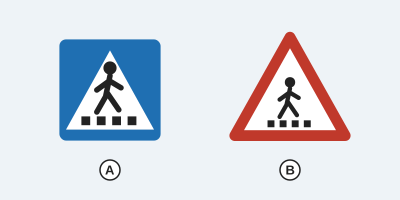
Question 14Which of these two signs is placed FARTHER from the pedestrian crossing?
ANeither; they are only used at schools
BBoth are placed at the same spot
CA, the blue square sign
DB, the red triangle warning sign ✓(correct answer)
Correct answer: D. The red-triangle warning sign warns in advance, so it is placed farther from the crossing than the blue sign marking the crossing itself.Source: Handbook p. 74
Question 15What does the blue square sign marked A tell you?
AA school is nearby
BYou are at the pedestrian crossing itself ✓(correct answer)
CA pedestrian crossing is some distance ahead
DPedestrians are prohibited
Correct answer: B. The blue sign marks the crossing location; the red triangle warning sign (B) is placed farther away to warn of the crossing ahead.Source: Handbook p. 74
Question 16You are approaching a pedestrian crossing. What should you do?
ASpeed up to pass before anyone steps out
BCheck both sides of the road for pedestrians, slow down and be prepared to stop ✓(correct answer)
CKeep your speed; pedestrians must wait for you
DSound the horn to warn pedestrians to wait
Correct answer: B. When approaching pedestrian zones, look around on both sides, slow down and be prepared to stop.Source: Handbook p. 75
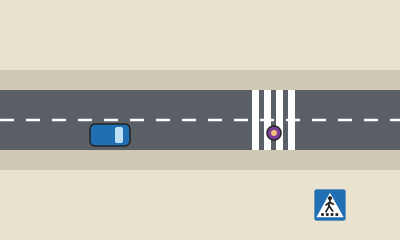
Question 17You are the blue car. A pedestrian is already crossing on the zebra crossing ahead. What do you do?
ASound the horn and continue
BStop and let the pedestrian finish crossing ✓(correct answer)
CContinue, because you are on the main road
DDrive around the pedestrian on the other side of the road
Correct answer: B. Do not obstruct pedestrians who have already started crossing; pedestrians have the right of way at marked crossings.Source: Handbook p. 75
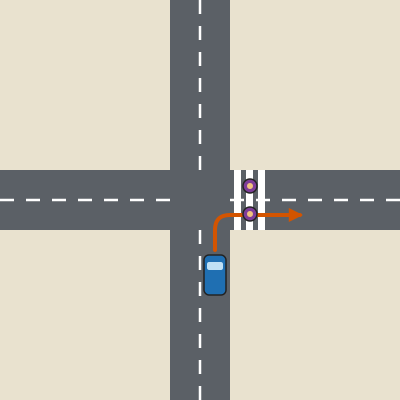
Question 18You (blue car) are turning right. Pedestrians are crossing the road you are turning into. What should you do?
AContinue; turning vehicles have priority over pedestrians
BTurn quickly before they reach your lane
CSound the horn so they stop
DGive way to the pedestrians and stop if necessary until they have crossed ✓(correct answer)
Correct answer: D. When turning at an intersection you must pay attention to pedestrians and, if necessary, stop until they cross.Source: Handbook p. 75
Question 19Which of the following is correct driver behaviour toward pedestrians on the sidewalk or roadside?
AFlash your lights to make them step back
BNever endanger their safety ✓(correct answer)
CDrive close to them so they move away
DIgnore them; they are not on the road
Correct answer: B. Do not endanger the safety of pedestrians on sidewalks or on the side of the road.Source: Handbook p. 75
Question 20A group of people walking together on a public road must:
ACarry a red flag
BWear reflective belts or vests ✓(correct answer)
CWalk only in the daytime
DWalk in the middle of the lane
Correct answer: B. Groups of people or herds of animals travelling on public roads must wear reflective belts or vests.Source: Handbook p. 76
Question 21 · extraHow should a large herd of animals cross a road?
AOnly at night when traffic is low
BWithout supervision, following the leader
CDivided into small groups, under guard ✓(correct answer)
DAll at once, as quickly as possible
Correct answer: C. Herds must be guarded; large flocks should be divided into small groups to make crossing the road easier.Source: Handbook p. 76