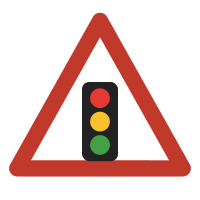
Traffic light questions cover what each signal means and where to stop. On red, stop at the stop line or before the signal pole and do not stand on the pedestrian crossing. Steady yellow means stop if you can do so safely, a flashing red light acts like a STOP sign, and a flashing yellow allows you to continue with great care. On green, start within a reasonable time but do not enter if you cannot clear the intersection. A right turn on red is allowed only if no signal prohibits it: stop for 2-3 seconds and turn below 15 km/h.
Correct answer: D. Traffic lights are announced in advance by a red-framed warning triangle showing a traffic light.Source: Handbook p. 123
Question 2The light turns red. Where must you stop?
AOn the pedestrian crossing
BAt the stop line, or not beyond the traffic light pole ✓(correct answer)
CAnywhere, as long as you slow down
DIn the middle of the intersection
Correct answer: B. At red, stop at the stop line or do not go beyond the level of the traffic light pole.Source: Handbook p. 124
Question 3The light is red and there is no stop line. Where should you stop?
AAt a point where you can still see the traffic lights ✓(correct answer)
BDirectly under the traffic light pole
CIn the middle of the junction
DAfter the pedestrian crossing
Correct answer: A. If there is no stop line, the driver must stop where he can see the traffic lights.Source: Handbook p. 124
Question 4After stopping at a red light, may your vehicle stand on the pedestrian crossing?
AYes, if no pedestrians are crossing
BYes, at night
CNo, you must not pass onto the pedestrian crossing ✓(correct answer)
DYes, if the car behind is too close
Correct answer: C. The driver must not pass the pedestrian crossing after stopping at a red light.Source: Handbook p. 124
Question 5At a red light, when may you turn right?
AWhen it is not prohibited by a traffic signal and it is safe to turn ✓(correct answer)
BNever
COnly between midnight and 6 a.m.
DOnly when a traffic officer is present
Correct answer: A. The driver may turn right on red unless a traffic light (signal) prohibits it, and must always make sure the turn is safe.Source: Handbook p. 124
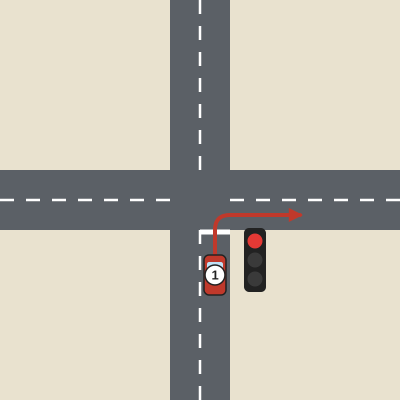
Question 6Car 1 wants to turn right. The light is red, there is no separate right-turn lane and no sign prohibiting the turn. What should the driver do?
AWait for the green light; right turns on red are never allowed
BSignal right, stop for 2-3 seconds, then turn slowly (under 15 km/h) if safe ✓(correct answer)
CSound the horn and turn quickly before the light changes
DTurn right without stopping, since right turns are free
Correct answer: B. Turning right on red is allowed unless prohibited: keep right, signal, stop once for 2-3 seconds, and turn at less than 15 km/h.Source: Handbook p. 126
Question 7When the light turns green, the driver must:
AStart driving within a reasonable time ✓(correct answer)
BWait at least 10 seconds before moving
CMove only after the car behind signals
DSound the horn before moving
Correct answer: A. When the light turns green, the driver must start driving within a reasonable time.Source: Handbook p. 124
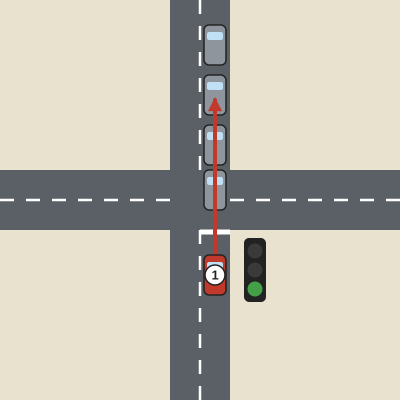
Question 8Car 1 has a green light, but the traffic on the other side of the intersection is stopped and car 1 could not clear the junction. What should car 1 do?
AEnter the intersection, because the light is green
BEnter and stop in the middle of the junction
CWait before the intersection until there is space to cross it ✓(correct answer)
DSound the horn to make the queue move
Correct answer: C. If traffic stops and you cannot cross, you must not enter the intersection even with a green light or the right of way.Source: Handbook p. 124
Question 9Does a green light always allow you to enter the intersection?
AYes, green always means you may enter
BYes, unless it is raining
CNo, only after the yellow light
DNo, not if traffic is stopped and you cannot cross the intersection ✓(correct answer)
Correct answer: D. Despite the green light or right of way, do not enter the intersection if you cannot cross it.Source: Handbook p. 124
Question 10The light turns yellow (orange) as you approach. You can stop safely without danger to anyone. What must you do?
ASound the horn and continue
BAccelerate to get through before red
CContinue at the same speed
DStop and do not cross the stop line ✓(correct answer)
Correct answer: D. Yellow means attention/stop: if you can stop without endangering yourself or others, you must stop before the stop line.Source: Handbook p. 124
Question 11What does a steady yellow (orange) traffic light mean?
AAttention - stop, if you can do so safely ✓(correct answer)
BSpeed up
CGo, the road is clear
DPedestrians must stop
Correct answer: A. Yellow/orange means attention/stop: stop if possible without endangering anyone.Source: Handbook p. 124
Question 12A flashing (intermittent) red light has the same meaning as:
AA give-way sign
BA no-parking sign
CA STOP sign ✓(correct answer)
DA green light
Correct answer: C. A flashing red light has the same meaning as the stop sign: stop at the stop line or the traffic light pole.Source: Handbook p. 125
Question 13You approach a flashing red light. Where must you stop?
AAt the stop line or at the level of the traffic light pole ✓(correct answer)
BYou don't need to stop, just slow down
COnly if a pedestrian is visible
DAfter the intersection
Correct answer: A. With a flashing red light, the driver must stop at the stop line or at the level of the traffic light pole.Source: Handbook p. 125
Question 14A flashing red light is installed at a railway crossing. What must you do?
AStop and not cross until the railway vehicles have cleared the way ✓(correct answer)
BSlow down and cross carefully
CCross quickly before the train arrives
DStop only if you can see the train
Correct answer: A. At a pedestrian or railway crossing, a flashing red light means you must not cross until pedestrians or railway vehicles have cleared the way.Source: Handbook p. 125
Question 15A flashing red light is installed at a pedestrian crossing and pedestrians are crossing. When may you move?
AWhen the first pedestrian reaches the middle
BOnly after the pedestrians have cleared the crossing ✓(correct answer)
CImmediately, flashing lights are only advisory
DAfter sounding the horn
Correct answer: B. You must not cross the pedestrian crossing and must not move before pedestrians have cleared the way.Source: Handbook p. 125
Question 16When approaching a flashing red light, what is always a good idea?
ABrake as hard as possible immediately
BTurn on the hazard lights and continue
CObserve your surroundings and make sure it is safe to stop ✓(correct answer)
DChange lanes to avoid stopping
Correct answer: C. Although a flashing red light means stop, it is always good to watch your surroundings and make sure it is safe to stop.Source: Handbook p. 125
Question 17What does a flashing (intermittent) yellow/orange light allow?
AStopping and waiting for green
BMaking a U-turn only
CDriving through at full speed
DContinuing to drive with great care and caution ✓(correct answer)
Correct answer: D. A flashing yellow light has the meaning of a right-of-way (give way) signal: you may continue with great care and caution.Source: Handbook p. 125
Question 18Even when turning right is allowed at a red light, what should you do near people and vehicles?
ASound the horn to warn them
BTurn as quickly as possible
CStop and pay close attention ✓(correct answer)
DUse the hazard lights instead of signalling
Correct answer: C. Even if right turns are allowed, make sure to stop and pay close attention while near people and vehicles.Source: Handbook p. 126
Question 19When turning right at a red light, what is the maximum speed the handbook allows for the turn?
ALess than 40 km/h
BThe road's speed limit
CLess than 15 km/h ✓(correct answer)
DLess than 30 km/h
Correct answer: C. Move slowly when turning right on red: your speed must be less than 15 km/h.Source: Handbook p. 126
Question 20When turning right at a red light, for how long should you stop before turning?
AUntil the light turns green
BOnce, for about 2-3 seconds ✓(correct answer)
CYou don't need to stop
DAt least 30 seconds
Correct answer: B. Stop the vehicle once (for 2-3 seconds) before making a right turn on red.Source: Handbook p. 126
Question 21Which lane position should you use before turning right at a red light?
AAny lane, as long as you signal
BThe far right side of the road ✓(correct answer)
CThe far left lane
DThe middle lane
Correct answer: B. Drive on the far right side of the road and stay there as much as possible, signal right, stop briefly, then turn slowly.Source: Handbook p. 126
Question 22At a red light, there is a separate dedicated lane for turning right. What applies?
AYou may turn right from any lane on red
BYou must wait for green in the left lane
CThe dedicated lane is only for buses
DYou must use that lane; you may not turn right on red at the intersection itself ✓(correct answer)
Correct answer: D. If there is a separate lane for turning right, you must take that lane and you are not allowed to turn right on red at that intersection.Source: Handbook p. 127
Question 23In which case are you NOT allowed to turn right at a red light?
AWhen there are no pedestrians
BWhen a signal prohibits turning on red ✓(correct answer)
CWhen the road to the right is empty
DWhen you have stopped for 3 seconds
Correct answer: B. Right turns on red are not allowed if a signal prohibits it, or if there is a dedicated right-turn lane you must use instead.Source: Handbook p. 127
Question 24An automatic monitoring camera takes a picture of your car at a junction. What does the handbook say?
AYour license is suspended immediately
BA fine is always issued automatically
CYou must report to the police within 24 hours
DIt doesn't necessarily mean a penalty; every picture is checked manually by staff ✓(correct answer)
Correct answer: D. A camera picture does not necessarily mean a penalty, since every picture is manually checked before a penalty is imposed.Source: Handbook p. 127