Trains always have priority at railway crossings. Crossings are secured with barriers, guards, traffic lights and bells, and a red or yellow light or a ringing bell means a train is approaching and you must not cross. Stop before the X signal or stop line when gates are moving or closed, and cross only when the gates are fully open and the red light is off. Never stop or drive along the rails, and clear the tracks immediately if a train is coming. Do not enter if there is no space on the far side to clear the tracks.
Correct answer: B. Railway vehicles have priority over other vehicles.Source: Handbook p. 158
Question 2You are on the railway tracks and a train is approaching. What must you do?
AFlash your lights at the train
BClear the tracks immediately ✓(correct answer)
CStop and wait for the train to brake
DReverse slowly along the rails
Correct answer: B. Drivers must immediately evacuate the railway tracks when a railway vehicle approaches.Source: Handbook p. 158
Question 3At a railway crossing, the traffic light shows red or yellow. What does it mean?
AA train is approaching - do not cross ✓(correct answer)
BThe crossing is closed for maintenance only
COnly trucks must stop
DCross quickly before the train arrives
Correct answer: A. Red or yellow lights at a railway crossing indicate an approaching train; drivers must not cross.Source: Handbook p. 158
Question 4You hear a bell ringing at a railway crossing. What does it mean?
AAn audible warning that a train is approaching - do not cross ✓(correct answer)
BThe crossing is safe to cross
CThe gates are about to open
DA guard is calling drivers forward
Correct answer: A. Bell signals give an audible warning of an approaching train; drivers should not cross.Source: Handbook p. 158
Question 5Which of the following is listed as a way railway crossings are secured and give advance warning?
ABarriers, a guard, traffic lights and bell signals ✓(correct answer)
BMirrors on the barriers
CPainted arrows only
DSpeed bumps on the tracks
Correct answer: A. Railway crossings are secured by barriers, a guard, traffic lights and bell signals.Source: Handbook p. 158
Question 6A guard at a railway crossing signals you to stop, but the barrier is still up. What do you do?
ADrive on, because the barrier is up
BCross only if you cannot see a train
CStop and obey the guard ✓(correct answer)
DSound the horn and cross slowly
Correct answer: C. Drivers must abide by the barriers or the guard, and a guard's signal to stop is one of the cases where you must stop.Source: Handbook p. 158
Question 7When may you cross a railway line?
AWhenever no barrier is visible
BWhen the yellow light flashes
COnly when the signal shows it is safe and you have made sure no train is approaching ✓(correct answer)
DWhen the train is still far away, even if the lights are red
Correct answer: C. The railway may only be crossed when the sign indicates it is safe, after making sure no train is approaching.Source: Handbook p. 158
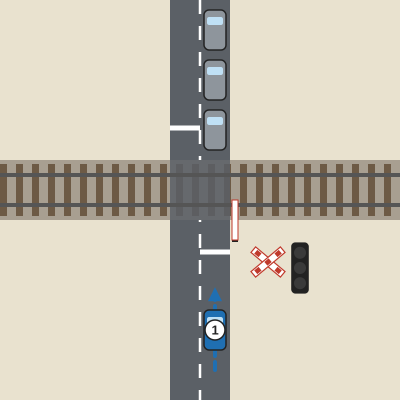
Question 8The lights are off and the gates are open, but traffic right after the tracks is jammed (no space for car 1). What should car 1 do?
AOvertake the queue on the left
BWait before the crossing until there is space to clear the tracks ✓(correct answer)
CCross, because the gates are open
DDrive onto the tracks and wait there
Correct answer: B. If traffic stops or slows and you might have to stop on the crossing, don't enter. Stopping on the rails is prohibited.Source: Handbook p. 158
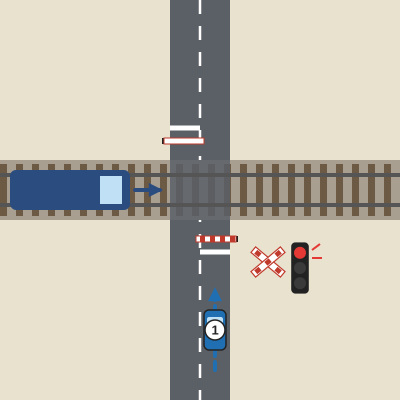
Question 9The barriers are closing, the red light is flashing and a train is approaching. Where must car 1 stop?
AOn the tracks, next to the barrier
BIt may continue if it is quick
CBefore the X signal / stop line ✓(correct answer)
DAfter the tracks
Correct answer: C. Vehicle drivers must stop before the X signal when a train approaches, the light is red or yellow, or the gates are moving or closed.Source: Handbook p. 159
Question 10In which of these situations must you stop before the X signal at a railway crossing?
AA vehicle behind you is very close
BThe gates are moving or closed ✓(correct answer)
CThere is no train in sight and the light is off
DThe gates are fully open and the lights are off
Correct answer: B. Stop before the X signal when a train approaches, there is a red or yellow light, the gates are moving or closed, a guard signals stop, or traffic doesn't allow crossing.Source: Handbook p. 159
Question 11This sign is placed at railway crossings. Where must you stop when a train approaches?
AAnywhere after it
BYou do not need to stop at this sign
CBefore this X signal ✓(correct answer)
DExactly beside it, on the tracks
Correct answer: C. Vehicle drivers must stop before the X signal when required (train approaching, lights, gates, guard, or traffic).Source: Handbook p. 159
Question 12Which of these is prohibited at railway crossings?
ASlowing down before the crossing
BWaiting behind the stop line
CChecking for trains in both directions
DStopping on the rails ✓(correct answer)
Correct answer: D. At railway crossings it is prohibited to stop on the rails, park on the railway, or drive along the rails.Source: Handbook p. 159
Question 13Which of these is also prohibited at railway crossings or tracks?
ALooking both ways
BDriving along the rails ✓(correct answer)
CStopping before the X signal
DCrossing when the gates are fully open and lights are off
Correct answer: B. Prohibited: stopping on rails, parking on the railway, and driving along the rails.Source: Handbook p. 159
Question 14The train has passed. When may you enter the railway crossing?
AAs soon as the train passes, even if the light is red
BWhen the gates are fully open and the red light is off ✓(correct answer)
CAs soon as the gates start to rise
DWhen the driver behind you sounds the horn
Correct answer: B. Wait until the gates are fully opened and the red light is off before entering.Source: Handbook p. 159
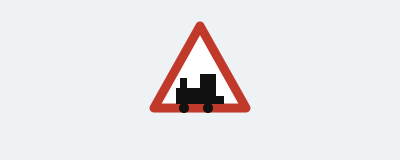
Question 15What does this warning sign mean?
AHeavy vehicles prohibited
BTram lane only
CRailway crossing ahead ✓(correct answer)
DTrain station parking
Correct answer: C. A red-bordered warning triangle with a locomotive warns of a railway crossing ahead.Source: Handbook p. 158
Question 16You see a red STOP sign reading 'Caution - train crossing'. What must you do?
AStop only if you hear a bell
BSlow down but do not stop
CSpeed up to cross quickly
DStop completely and make sure no train is coming before crossing ✓(correct answer)
Correct answer: D. STOP means a full stop; at a railway crossing you may only continue after making sure no train is approaching.Source: Handbook p. 158