Priority rules apply at intersections not controlled by traffic lights or an officer. At an intersection of equal roads, the vehicle closest to the intersection goes first; if vehicles arrive at the same time, the vehicle coming from the right has priority. A vehicle going straight has priority over one turning left or changing lanes across its path, and a U-turning vehicle goes last. Emergency vehicles always have priority. Where roadworks close part of a road, the driver whose side is open goes first. If a situation is unclear, make eye contact and give way to avoid an accident.
Question 1Where do the priority (right-of-way) rules apply?
AOnly at intersections with traffic lights
BOnly on highways
COnly in residential areas
DAt intersections not controlled by traffic lights or a traffic officer ✓(correct answer)
Correct answer: D. Priority rules must be observed at intersections not controlled by a traffic light or traffic officer.Source: Handbook p. 131
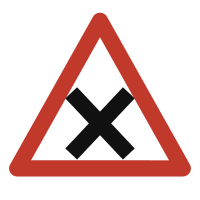
Question 2What does this warning sign announce?
ANo entry
BRailway crossing ahead
CEnd of all restrictions
DA crossroads (intersection) ahead ✓(correct answer)
Correct answer: D. Warning triangles prepare you for an intersection ahead; the X symbol shows a crossroads.Source: Handbook p. 131
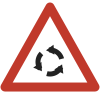
Question 3What does this warning sign announce?
ARoad works ahead
BU-turn allowed
CA roundabout ahead ✓(correct answer)
DTwo-way traffic ahead
Correct answer: C. This warning triangle with circular arrows announces a roundabout ahead.Source: Handbook p. 131
Question 4Emergency vehicles performing their duties:
AAlways have priority; clear the way for them as soon as possible ✓(correct answer)
BMust follow the right-before-left rule
CHave priority only on highways
DHave priority only at traffic lights
Correct answer: A. Priority must be given to emergency vehicles while on duty; they always have priority and you must clear the way.Source: Handbook p. 132
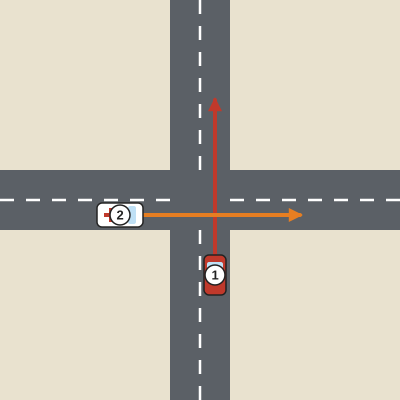
Question 5An ambulance (2) on an emergency call and car 1 reach an intersection without signs at the same time. Who goes first?
ACar 1, because it comes from the ambulance's right
BThe ambulance (2) ✓(correct answer)
CCar 1, because it is going straight
DNeither; both must wait for a traffic officer
Correct answer: B. Car 1 is on the ambulance's right, but emergency vehicles on duty always have priority.Source: Handbook p. 132
Question 6At an intersection of equal roads (no road has priority), which TWO rules decide who goes first?
AThe vehicle turning, then the vehicle going straight
BLeft before right, then the slower vehicle
CThe faster vehicle, then the larger vehicle
DThe vehicle closest to the intersection, then right before left ✓(correct answer)
Correct answer: D. For equal roads: the vehicle closest to the intersection has priority, and the right-before-left rule applies.Source: Handbook p. 133
Question 7Car 1 is just entering the intersection; car 2 is still far away. There are no signs or lights. Who has priority?
ANeither; both must stop
BCar 2, because it comes from the right
CCar 1, because it is closest and enters first ✓(correct answer)
DCar 2, because it is going straight
Correct answer: C. When vehicles do not arrive at the same time, the vehicle closest to the intersection (entering first) has priority.Source: Handbook p. 134
Question 8Car 1 has reached the intersection; car 2 (on car 1's right) is still far away. There are no signs or lights. Who has priority?
AThe car that sounds its horn first
BCar 1, because it is closest to the intersection ✓(correct answer)
CCar 2, because it comes from the right
DCar 2, because it is faster
Correct answer: B. Right-before-left only applies when vehicles arrive at the same time. Here car 1 is clearly closer, so it enters first.Source: Handbook p. 134
Question 9Two vehicles approach an equal intersection but NOT at the same time. Who has priority?
AThe vehicle on the right
BThe vehicle that is closest to the intersection ✓(correct answer)
CThe larger vehicle
DThe vehicle going straight
Correct answer: B. If they do not arrive at the same time, the vehicle closest to the intersection (that enters first) has priority.Source: Handbook p. 134
Question 10You are closest to the intersection and have priority. What must you still do?
AAccelerate to clear the junction quickly
BMonitor traffic and not stop or change direction in a way that causes an accident ✓(correct answer)
CNothing; priority means you can ignore others
DSound the horn continuously
Correct answer: B. Even with priority, the driver must monitor traffic and assess the situation, and must not stop or change direction suddenly causing an accident.Source: Handbook p. 134
Question 11Two vehicles approach an intersection of equal roads at the same time. Who has priority?
AThe vehicle coming from the right ✓(correct answer)
BThe vehicle coming from the left
CThe vehicle turning left
DThe faster vehicle
Correct answer: A. Right before left: at the same time on equal roads, the vehicle on the right has the right of way.Source: Handbook p. 135
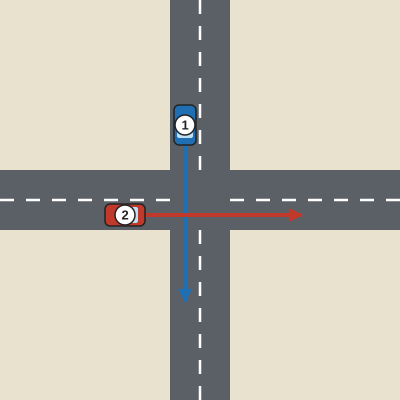
Question 12Both cars reach this equal intersection at the same time. Who has priority?
AWhichever is faster
BCar 1 ✓(correct answer)
CCar 2
DNeither; both must reverse
Correct answer: B. Car 1 approaches from car 2's right, so car 1 has priority (right before left).Source: Handbook p. 135
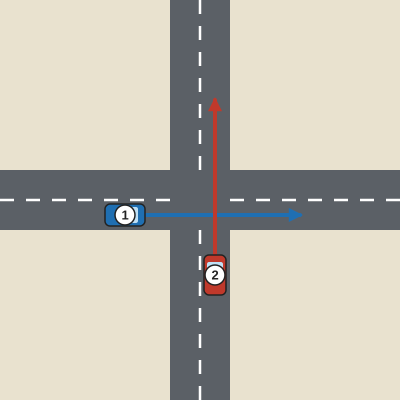
Question 13Both cars reach this equal intersection at the same time. Who has priority?
AWhichever is faster
BCar 2 ✓(correct answer)
CNeither; both must wait
DCar 1
Correct answer: B. Car 2 approaches from car 1's right, so car 2 has priority.Source: Handbook p. 135
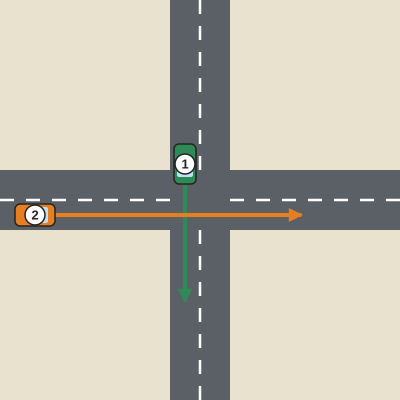
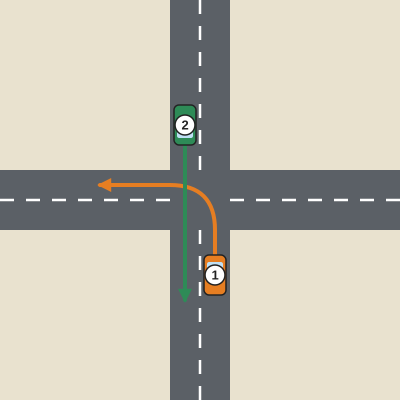
Question 14Both cars reach this equal intersection at the same time. Who has priority?
ACar 1, because it comes from the north
BNeither; both must wait for a traffic officer
CCar 2 ✓(correct answer)
DCar 1
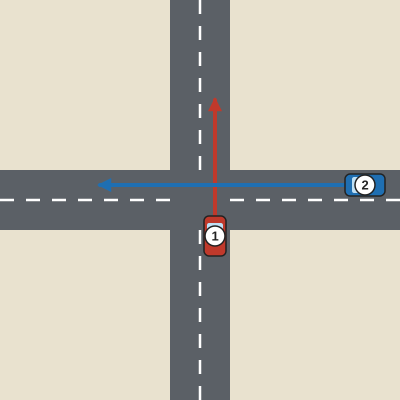
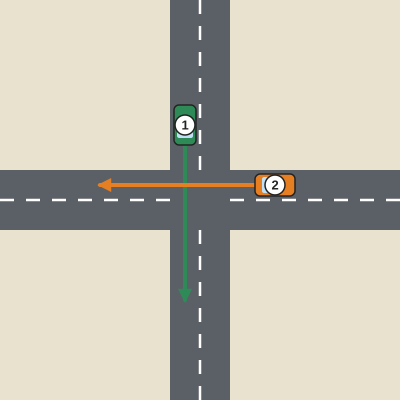
Correct answer: C. Car 1 is heading south, so its right side is the west. Car 2 comes from the west, i.e. from car 1's right, so car 2 goes first.Source: Handbook p. 135
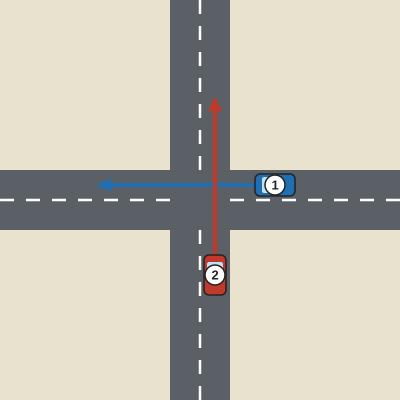
Question 15Both cars reach this equal intersection at the same time. Who has priority?
ANeither; both must wait
BWhichever is faster
CCar 1 ✓(correct answer)
DCar 2
Correct answer: C. Car 2 is heading west, so its right side is the north, where car 1 comes from. Car 1 is on car 2's right and goes first.Source: Handbook p. 135
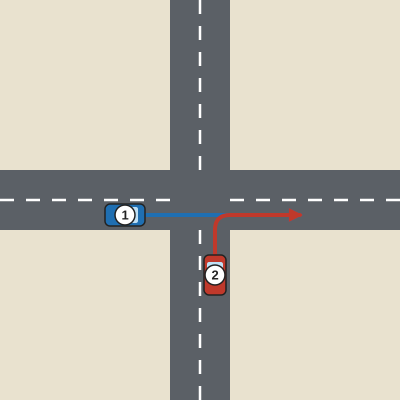
Question 16Both cars arrive at the same time. Car 2 turns right; car 1 goes straight. Who has priority?
ACar 2, because it comes from car 1's right ✓(correct answer)
BCar 1, because it is going straight
CCar 1, because car 2 is turning
DBoth may drive at the same time
Correct answer: A. What matters is the direction a vehicle approaches from, not where it is heading. Car 2 approaches from car 1's right.Source: Handbook p. 135
Question 17When applying the right-before-left rule, what matters most?
AThe speed of each vehicle
BThe size of each vehicle
CThe direction each vehicle is heading to
DThe direction from which each vehicle approaches the intersection ✓(correct answer)
Correct answer: D. The most important thing is from which direction the vehicles approach, not which direction they are heading.Source: Handbook p. 135
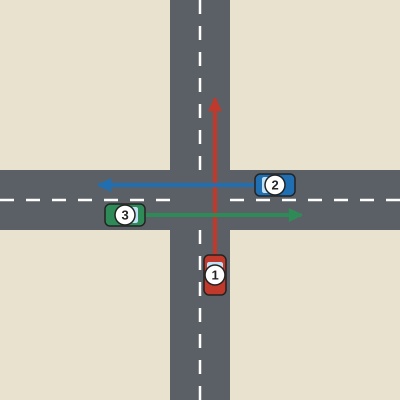
Question 18All three cars reach this equal intersection at the same time and go straight. In what order do they pass?
A2, then 1, then 3 ✓(correct answer)
B2, then 3, then 1
C1, then 2, then 3
D3, then 1, then 2
Correct answer: A. Car 2 has no one on its right, so it goes first. Then car 1 (car 2 was on its right). Car 3 has car 1 on its right, so it goes last.Source: Handbook p. 135
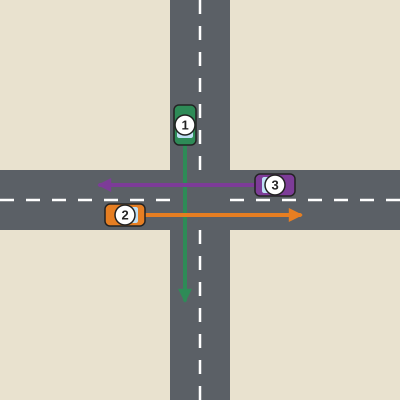
Question 19All three cars reach this equal intersection at the same time and go straight. In what order do they pass?
A1, then 3, then 2
B3, then 2, then 1
C1, then 2, then 3
D2, then 1, then 3 ✓(correct answer)
Correct answer: D. Car 2 (from the west) has nobody on its right (south), so it goes first. Car 1 has car 2 on its right, so it goes next. Car 3 has car 1 on its right, so it goes last.Source: Handbook p. 135
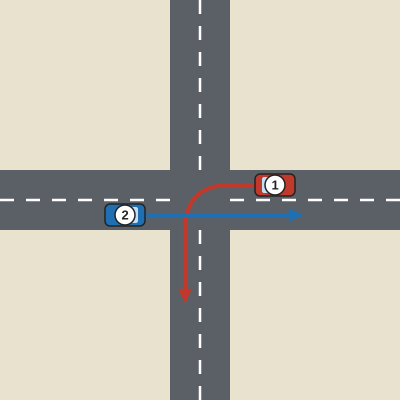
Question 20Car 1 wants to turn left; car 2 comes from the opposite direction and goes straight. Who goes first?
ACar 1, because it arrived first
BCar 1, because turning vehicles have priority
CBoth at the same time
DCar 2, because it is going straight ✓(correct answer)
Correct answer: D. A vehicle going straight has priority over an oncoming vehicle turning left.Source: Handbook p. 136
Question 21Car 1 wants to turn left; car 2 comes from the opposite direction and goes straight. Who goes first?
ACar 1
BThe faster car
CNeither; both must wait
DCar 2 ✓(correct answer)
Correct answer: D. The oncoming car going straight (car 2) has priority over the car turning left (car 1).Source: Handbook p. 136
Question 22You want to turn left at an equal intersection, and a car is approaching from the opposite direction going straight. What should you do?
ALet the oncoming car pass first, then turn ✓(correct answer)
BSound the horn and turn
CTurn because you signalled first
DTurn quickly before it arrives
Correct answer: A. Vehicles driving straight have priority over vehicles turning left across their path.Source: Handbook p. 136
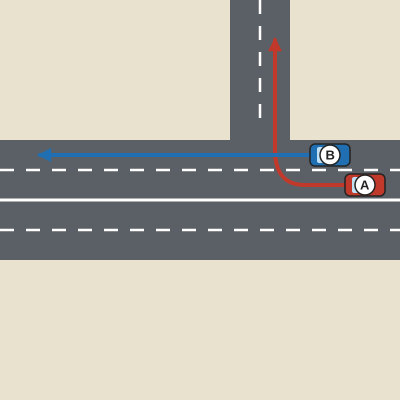
Question 23Cars A and B drive in the same direction. A wants to turn right into the side road while B continues straight. Who has priority?
AA, because it signalled
BWhichever is ahead
CB, because it is going straight ✓(correct answer)
DA, because it is turning right
Correct answer: C. For vehicles moving in parallel, the driver going straight has priority over the driver who wants to change direction.Source: Handbook p. 137
Question 24Two vehicles move in parallel in the same direction. One wants to change direction across the other's path. Who has priority?
AThe vehicle changing direction
BThe larger vehicle
CThe vehicle going straight ✓(correct answer)
DThe vehicle on the left
Correct answer: C. A driver traveling in a straight line has priority over a driver wishing to change direction.Source: Handbook p. 137
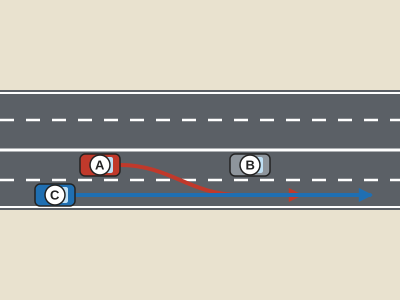
Question 25Car A wants to move into the lane where car C is driving straight. Who has priority?
ACar A
BCar C ✓(correct answer)
CWhichever is faster
DCar B
Correct answer: B. The driver going straight ahead (C) has priority over the driver changing lane/direction (A).Source: Handbook p. 138
Question 26On a multi-lane road, you want to change into the next lane, where another car is driving straight. What should you do?
AChange lanes, because you signalled
BBrake suddenly in your own lane
CLet the car in that lane pass, and change lanes only when it is safe ✓(correct answer)
DSpeed up and cut in front
Correct answer: C. A driver who is driving straight ahead has priority over drivers who are changing direction.Source: Handbook p. 138
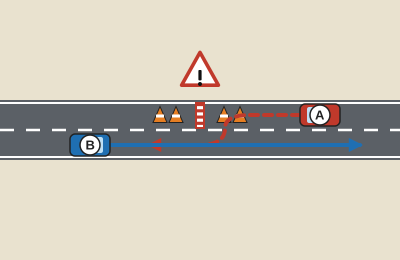
Question 27Road works close part of this two-way road. Cars A and B meet at the obstacle. Who has priority?
AA, because it arrived at the obstacle first
BB, because the road ahead on its side is open ✓(correct answer)
CA, because it is bigger
DBoth may pass at the same time
Correct answer: B. On a partially closed road, priority goes to the driver whose road ahead is open on the right side. The obstacle is in A's lane, so A must wait.Source: Handbook p. 139
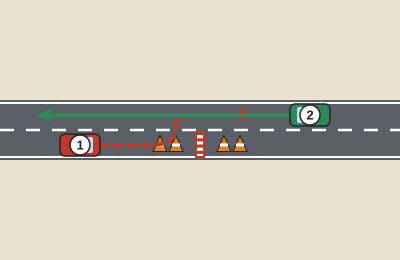
Question 28The obstacle is in car 1's lane. Car 2 comes from the opposite direction. What is correct?
ACar 2 goes first; then car 1 may use the left side to pass the obstacle ✓(correct answer)
BBoth cars must wait for a traffic officer
CCar 1 must turn around
DCar 1 goes first because it must change lanes
Correct answer: A. The driver whose side is open (car 2) has priority. Car 1 may use the left side of the road once it is clear.Source: Handbook p. 139
Question 29On a partially closed two-way road, two drivers meet. Who has priority?
AThe driver who arrived first at the obstacle
BThe driver whose side of the road ahead (on the right) is open ✓(correct answer)
CThe larger vehicle
DThe driver whose lane is closed
Correct answer: B. Priority is given to the driver with the road ahead open on the right.Source: Handbook p. 139
Question 30The right side of the road is closed due to construction. What may you do?
ADrive on the sidewalk
BReverse back to the last junction
CUse the left side of the road, when it is safe ✓(correct answer)
DWait until the construction work is finished
Correct answer: C. The driver can use the left side of the road if the right side is closed due to construction work or other reasons.Source: Handbook p. 139
Question 31A section of a two-way road is closed and a road worker is directing traffic. What must you do?
AComply with the road worker's instructions ✓(correct answer)
BApply the right-before-left rule
CIgnore him; only police may direct traffic
DFollow only the road signs
Correct answer: A. When a section of a two-way road is closed, the driver must comply with the instructions of the traffic department, security forces or road workers.Source: Handbook p. 139
Question 32Two drivers meet on a partially closed road. What must both of them do?
ASound their horns and continue
BSpeed up to pass the obstacle first
CReduce speed and stop if necessary to avoid an accident ✓(correct answer)
DFlash their headlights and keep going
Correct answer: C. If two drivers meet on a (partially) closed road, both must reduce speed and stop if necessary to avoid an accident.Source: Handbook p. 139
Question 33What is the purpose of the priority (right-of-way) rules?
ATo replace traffic lights everywhere
BTo let faster vehicles pass first
CTo give large vehicles priority
DTo make clear when drivers must give way to other road users ✓(correct answer)
Correct answer: D. Priority rules make clear when drivers must give way; following them improves safety and reduces accidents.Source: Handbook p. 154
Question 34Which of these is given as an example of an UNCLEAR right-of-way situation?
AA police officer is directing traffic
BA traffic light is showing green
CMore than one vehicle has stopped at the crossing point ✓(correct answer)
DYou are driving on the highway
Correct answer: C. Unclear cases include more than one vehicle stopping at the crossing point, or another road user clearly unable to follow the priority rules.Source: Handbook p. 154
Question 35You have priority, but another driver is clearly unable to follow the priority rules. What is recommended?
ASpeed up to pass before the other driver
BInsist on your right of way
CSound your horn and drive on
DMake eye contact and give up your right of way if that helps avoid an accident ✓(correct answer)
Correct answer: D. In unclear cases, make eye contact and refrain from using your right of way if that helps avoid an accident.Source: Handbook p. 154
Question 36Several vehicles have stopped at a junction and it is unclear who should go. What does the handbook recommend first?
AWait until a traffic officer arrives
BMake eye contact with the other road users ✓(correct answer)
CReverse away from the junction
DGo first, before anyone else does
Correct answer: B. It is recommended to make eye contact with the other road user and make room if that avoids an accident.Source: Handbook p. 154