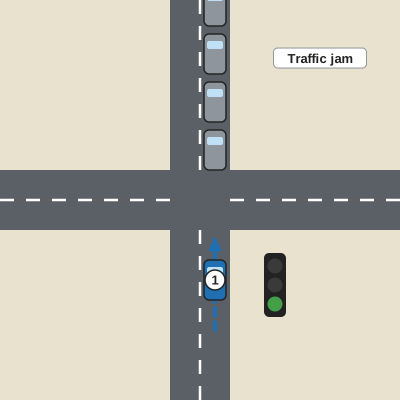
This topic walks through the steps for dealing with an intersection. Approach cautiously and reduce speed so you can stop if others have priority. The handbook describes a sequence of look around, evaluate, decide and act, and approach actions such as checking mirrors, signalling, positioning, adjusting speed and looking around. When evaluating, consider other road users' speed, age, attention, intent and distances. Even with a green light or the right of way, do not enter if traffic ahead is jammed and you could get stuck blocking the intersection.
Question 1How should you approach an intersection?
ACautiously, reducing speed so you can stop before it if others have priority ✓(correct answer)
BQuickly, to clear it as soon as possible
CAt constant speed, if you think you have priority
DUsing the horn to warn other drivers
Correct answer: A. Approach cautiously and reduce speed so you can stop before the crossing if other road users have priority.Source: Handbook p. 153
Question 2Your light (car 1) is green, but traffic beyond the intersection is jammed and there is no space to clear it. What should you do?
ATurn on hazard lights and enter slowly
BEnter, because the light is green
CEnter and stop in the middle of the intersection
DWait before the intersection until there is room to clear it ✓(correct answer)
Correct answer: D. If you cannot cross, stop before the intersection even with a green light; if you might get stuck, don't enter at all.Source: Handbook p. 153
Question 3You have the right of way, but slow traffic means you might get stuck in the intersection. What does the handbook say?
AEnter only if you sound the horn first
BEnter and use your hazard lights
CEnter, because you have the right of way
DDo not enter the intersection ✓(correct answer)
Correct answer: D. If there is a danger of getting stuck in the intersection due to slow or stopped traffic, avoid entering it from the start, even with right-of-way.Source: Handbook p. 153
Question 4What is the correct order of steps when entering a crossing (intersection)?
ALook around, evaluate the situation, make a decision, act ✓(correct answer)
BMake a decision, act, look around, evaluate
CAct, look around, make a decision, evaluate
DEvaluate, act, look around, make a decision
Correct answer: A. Entering the crossing: look around, evaluate the situation, make a decision, act.Source: Handbook p. 155
Question 5When APPROACHING a crossing, which group of actions does the handbook list?
ATurn on hazard lights, stop, reverse
BCheck mirrors, signal, position the vehicle, adjust speed, look around ✓(correct answer)
CSwitch off the radio, open the window, honk
DAccelerate, sound the horn, change lanes
Correct answer: B. Approaching the crossing: check mirrors, give a signal, vehicle positioning, speed, looking around.Source: Handbook p. 155
Question 6When evaluating the situation at a crossing, what should you assess about other road users?
AOnly the number of passengers
BTheir vehicle brand and colour
CTheir speed, age, attention, intent and distances ✓(correct answer)
DOnly their speed
Correct answer: C. Status rating: speed, age, attention, intent and distances of other road users.Source: Handbook p. 155
Question 7In the crossing procedure, what does 'looking around' mean?
AChecking both sides to make sure no one else is in the way ✓(correct answer)
BLooking only straight ahead
CLooking at the dashboard
DLooking only in the rear-view mirror
Correct answer: A. Looking around: check on both sides and check that there are no others in the way.Source: Handbook p. 155
Question 8In the crossing procedure, the final 'act' step means deciding:
AWhether to switch off the engine
BWhether to wait or move ✓(correct answer)
CWhich radio station to listen to
DWhether to report the other driver
Correct answer: B. After deciding whether it is safe to continue, you act: wait or move.Source: Handbook p. 155