This topic explains who goes first where highways meet other roads. A driver on the highway has priority over a driver joining from a secondary road, so a car on an entry ramp must make sure the road is clear and give way, although a highway driver who moves over to make space is showing good cooperative behaviour. When leaving the highway onto a service road, the vehicle coming from the highway has priority over vehicles already on the service road, and drivers on the service road should make way if possible.
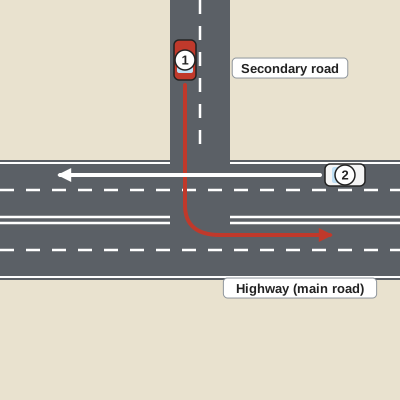
Question 1Car 1 is leaving a secondary road and wants to turn onto the highway. Car 2 is on the highway. Who has priority?
ACar 2, because it is on the highway ✓(correct answer)
BCar 1, because car 2 approaches from car 1's left
CCar 1, because it reached the junction first
DNeither; both must stop
Correct answer: A. The driver on the highway has the right of way over a driver coming from a secondary road. The right-before-left rule only applies between equal roads.Source: Handbook p. 142
Question 2Who has priority: a driver on the highway, or a driver coming from a secondary road?
AThe driver coming from the secondary road
BThe driver on the right
CThe faster driver
DThe driver on the highway ✓(correct answer)
Correct answer: D. The driver on the highway has the right of way compared to the driver coming from a secondary road.Source: Handbook p. 142
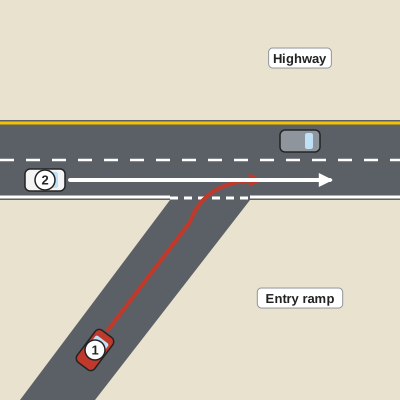
Question 3Car 1 is on the entry ramp joining the highway; car 2 is in the highway's right lane. What must car 1 do?
ASound the horn to warn car 2
BMake sure the road is clear and give way to car 2 ✓(correct answer)
CStop at the end of the ramp in all cases, even if the road is clear
DEnter immediately; car 2 must brake
Correct answer: B. When entering from a secondary road, the driver must ensure the road is clear and give way to vehicles on the highway.Source: Handbook p. 143
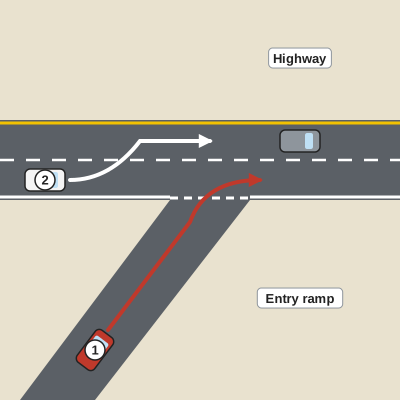
Question 4Car 1 is joining the highway from the ramp. Car 2 moves to the left lane to make space for it. How does the handbook describe car 2's behaviour?
AA violation, because car 2 had priority
BCorrect cooperative behaviour ✓(correct answer)
CDangerous, because changing lanes is forbidden on highways
DUnnecessary, because car 1 has priority
Correct answer: B. The driver on the highway must give the driver coming from the secondary road an opportunity to enter - this is correct cooperative behaviour.Source: Handbook p. 144
Question 5You are driving on the highway and a vehicle is joining from a secondary road. What does the handbook expect of you?
AGive the joining driver an opportunity to enter ✓(correct answer)
BFlash your lights to warn it to stay back
CSpeed up so the joining driver has to wait
DStop completely in your lane
Correct answer: A. Although you have priority, the driver on the highway must give the driver from the secondary road an opportunity to enter.Source: Handbook p. 143
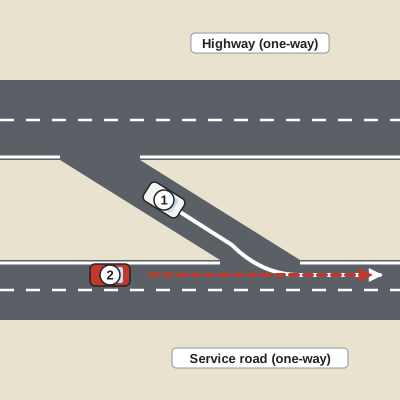
Question 6Car 1 is leaving the highway for the service road. Car 2 is already driving on the service road. Who has priority?
AWhoever is driving faster
BCar 2, because it is on the left
CCar 2, because it is already on the service road
DCar 1, coming from the highway ✓(correct answer)
Correct answer: D. Traffic priority is given to vehicles leaving the highway to the service road.Source: Handbook p. 146
Question 7You are driving on the service road and a vehicle is leaving the highway into your road. What should you do?
ASound the horn and accelerate
BKeep your speed; you have priority on the service road
CStop completely in all cases
DIf possible, make way for the vehicle coming from the highway ✓(correct answer)
Correct answer: D. The vehicle coming from the highway has priority; if possible, the service-road driver must open the way for it.Source: Handbook p. 147
Question 8Which statement about highways and service roads is correct?
AA vehicle leaving the highway for the service road has priority over vehicles on the service road ✓(correct answer)
BA vehicle entering the highway has priority over vehicles on the highway
CVehicles on the highway must stop for vehicles waiting to enter
DA vehicle on the service road always has priority over vehicles leaving the highway
Correct answer: A. Vehicles on the highway have priority over those entering it, and vehicles leaving the highway have priority over those on the service road.Source: Handbook p. 146