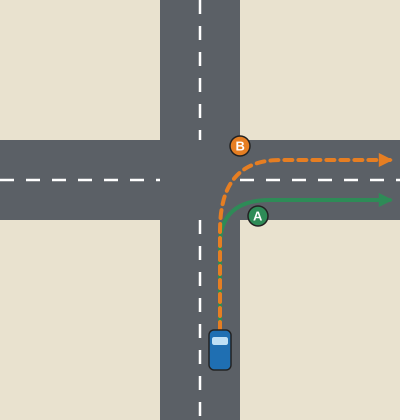
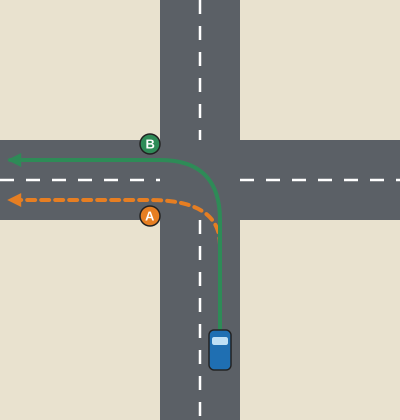
This topic explains how to turn and reverse correctly. Signal early enough for others to see your intention, slow down well before the turn without braking suddenly, and keep a sufficient distance from the vehicle ahead. Right turns use a tight curve staying on the far right, while left turns use a wide curve that ends on the right side of the new road. Reversing on a public road is allowed only when necessary and for a short distance, with a maximum of 20 metres. It is prohibited on highways, even if you miss your exit.
DEarly enough for others to see your intention ✓(correct answer)
Correct answer: D. Each turn must be signalled early enough with the turn signal.Source: Handbook p. 117
Question 2How should you reduce speed before a turn?
ABrake hard just before the turn
BKeep your speed and brake in the turn
CUse only the hand-brake
DSlow down early, without sudden hard braking ✓(correct answer)
Correct answer: D. The driver must slow down early and avoid unnecessary hard braking.Source: Handbook p. 117
Question 3When preparing to turn, what distance should you keep from the vehicle in front?
AA sufficient distance ✓(correct answer)
BAs close as possible to save space
CNo distance needed at low speed
DExactly one metre
Correct answer: A. When turning, keep a sufficient distance between you and the vehicle in front.Source: Handbook p. 117
Question 4Which path is correct for turning RIGHT?
AB - a wide curve into the far lane
BA - a tight curve, staying on the far right ✓(correct answer)
CBoth are correct
DNeither; stop in the junction first
Correct answer: B. Turn right through a narrow (tight) bend and stay on the far right side of the road.Source: Handbook p. 117
Question 5Which path is correct for turning LEFT?
AA - cutting the corner
BNeither; left turns are made by reversing
CB - a wide curve ending on the right side of the new road ✓(correct answer)
DBoth are correct
Correct answer: C. A left turn is done through a wide curve, ending on the right side of the other road.Source: Handbook p. 118
Question 6Which statement about turning is correct?
ABoth turns should cut the corner
BRight turns use a wide curve; left turns use a tight curve
CBoth turns should use the widest curve possible
DRight turns use a tight curve; left turns use a wide curve ✓(correct answer)
Correct answer: D. Right turn: narrow bend, far right. Left turn: wide curve, ending on the right side of the other road.Source: Handbook p. 117
Question 7After turning left, on which side of the new road should you be?
AThe left side
BIn the middle, on the centre line
COn whichever side is empty
DThe right side ✓(correct answer)
Correct answer: D. The left turn ends on the right side of the other road.Source: Handbook p. 118
Question 8What is the maximum distance you may reverse on a public road, when it is necessary?
A50 metres
B5 metres
C20 metres ✓(correct answer)
D100 metres
Correct answer: C. Reversing on public roads is only allowed when necessary and for no more than 20 metres.Source: Handbook p. 119
Question 9You miss your exit on a highway. May you reverse back to it?
AYes, if it is less than 20 metres
BYes, with hazard lights on
CYes, on the shoulder
DNo, reversing is prohibited on highways ✓(correct answer)
Correct answer: D. Reverse driving is prohibited on highways. Continue to the next exit.Source: Handbook p. 119
Question 10When is reversing on a public road permitted?
ANever, not even for parking
BAny time the road is empty
CWhenever it is faster than going around
DOnly in cases of necessity, for a short distance ✓(correct answer)
Correct answer: D. Driving backwards on public roads is not permitted except when necessary, for no more than 20 metres.Source: Handbook p. 119
Question 11What must you do before reversing?
ASound the horn and reverse quickly
BTurn off your lights
CMake sure the road is clear and reversing won't endanger anyone ✓(correct answer)
DNothing, if you reverse slowly
Correct answer: C. Reversing must be clearly indicated, and the driver must make sure the road is clear and safe for other road users.Source: Handbook p. 119
Question 12How should reversing be done regarding other road users?
AIt must be clearly indicated to them ✓(correct answer)
BIt should be done without warning
COnly at night
DOnly trucks need to indicate it
Correct answer: A. The handbook states reversing must be clearly indicated.Source: Handbook p. 119