Planning your lane early lets you signal in time and avoid last-minute moves. Without lane arrows, position yourself on the far right to turn right, and toward the middle but right of the dividing line to turn left or make a U-turn on a two-way road. With arrows, use the lane that matches your move, and choose among several left-turn lanes by what you need after the turn. The topic also explains roundabout lanes and signals for the first, second, third and fourth exits, including when to switch from a left to a right signal.
Question 1Before moving into a lane to turn, what must you check?
AThat the car behind you is a small car
BThat the turn is not prohibited by traffic lights or other signals ✓(correct answer)
CThat your fuel tank is full
DThat the radio is off
Correct answer: B. Make sure the turn isn't blocked by lights or signals, signal in time, don't put others at risk, and follow the direction signs.Source: Handbook p. 108
Question 2Why is it important to plan your lane in advance?
ASo you never need to use signals
BSo you can ignore the direction signs
CSo you can cut across lanes at the last moment
DSo you can signal in time and move to the correct lane without putting others at risk ✓(correct answer)
Correct answer: D. A timely lane change must be signalled, other road users must not be put at risk, and you must follow direction signs.Source: Handbook p. 108
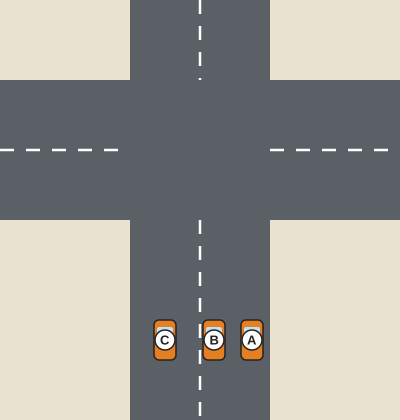
Question 3There are no lane arrows. You want to turn right at the junction. Which position is correct?
AA - at the far right of the road ✓(correct answer)
BAny position, as long as you signal
CB - near the centre line
DC - left of the centre line
Correct answer: A. Without lane arrows, the driver must turn right from the far right side of the road.Source: Handbook p. 109
Question 4There are no lane arrows on this two-way road. You want to turn left. Which position is correct?
AIn the oncoming lane, close to the left kerb
BB - toward the middle of the road, right of the centre line ✓(correct answer)
CA - at the far right of the road
DC - across the centre line
Correct answer: B. To turn left on a two-way street, move to the middle of the road but stay to the right of the dividing line.Source: Handbook p. 109
Question 5Turning left on a two-way road with a dividing line and no lane arrows, where should you position your car?
AAt the far right edge of the road
BOn top of the dividing line
CToward the middle of the road, but still to the right of the dividing line ✓(correct answer)
DTo the left of the dividing line
Correct answer: C. Move to the middle and remain to the right of the dividing line.Source: Handbook p. 109
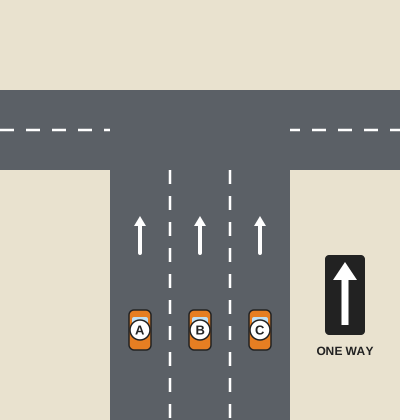
Question 6You are on this one-way road and want to turn left at the junction. Which car is positioned correctly?
AAny lane, since it is one-way
BA - the left lane ✓(correct answer)
CC - the right lane
DB - the middle lane
Correct answer: B. On one-way roads, the driver must turn left from the left side of the road.Source: Handbook p. 109
Question 7You are on this one-way road and want to turn right at the junction. Which car is positioned correctly?
AAny lane, since it is one-way
BC - the right lane ✓(correct answer)
CA - the left lane
DB - the middle lane
Correct answer: B. Without arrows, right turns are made from the far right side of the road.Source: Handbook p. 109
Question 8You want to make a U-turn on a two-way road with a dividing line and no lane arrows. Where should you position your car?
AAt the far right edge of the road
BIn the oncoming lane
COn the dividing line
DIn the middle of the road, to the right of the dividing line ✓(correct answer)
Correct answer: D. For a U-turn on a two-way street, move to the middle of the road and remain right of the dividing line.Source: Handbook p. 109
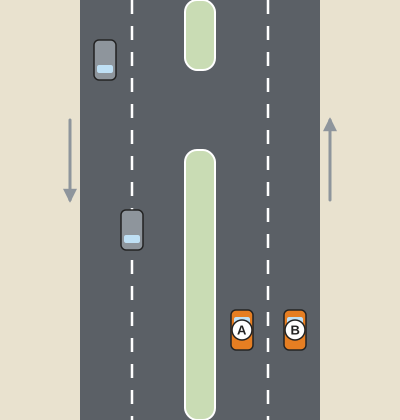
Question 9You want to make a U-turn through the gap in the central island ahead. Which car is positioned correctly?
AB - the right lane
BA - the left lane, next to the island ✓(correct answer)
CEither lane
DStop on the right shoulder first, then cross all lanes
Correct answer: B. On roads that are one-way or have a central island, make the U-turn from the left side of the road (to the right of the island).Source: Handbook p. 109
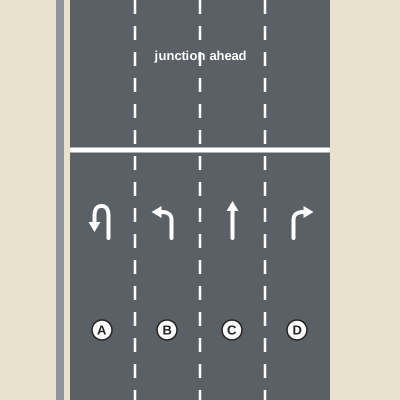
Question 10Which lane must you use to turn RIGHT here?
AA
BB
CD ✓(correct answer)
DC
Correct answer: C. When lane arrows are present, turn right from the lane with the right-pointing arrow.Source: Handbook p. 110
Question 11Which lane must you use to turn LEFT here?
AC
BB ✓(correct answer)
CA
DD
Correct answer: B. Turn left from the lane with the left-pointing arrow. Lane A is marked for U-turns.Source: Handbook p. 110
Question 12Which lane must you use to make a U-turn here?
AD
BA ✓(correct answer)
CC
DB
Correct answer: B. Make a U-turn from the lane with the U-turn arrow.Source: Handbook p. 110
Question 13Which lane must you use to go STRAIGHT ahead here?
AC ✓(correct answer)
BD
CA
DB
Correct answer: A. Lane arrows show which movement each lane is for; lane C has the straight-ahead arrow.Source: Handbook p. 110
Question 14When lanes are marked with direction arrows, from which lane must you turn left?
AThe lane with an arrow pointing left ✓(correct answer)
BThe far-left lane, whatever its arrow
CThe lane with the straight-ahead arrow
DAny lane, if you signal early
Correct answer: A. With road arrows, turn left only from a lane where the arrow points to the left.Source: Handbook p. 110
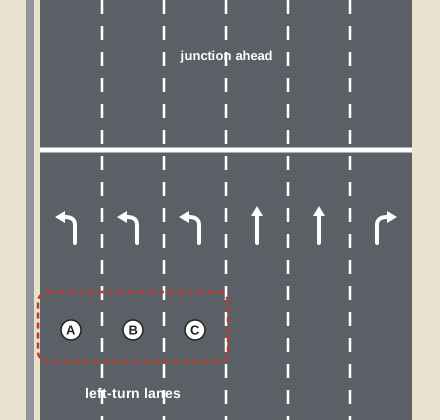
Question 15You will turn left here and then turn RIGHT at the next junction. Which left-turn lane should you take?
AC - the right-most left-turn lane ✓(correct answer)
BAny of them; change lanes after the turn
CA - the left-most left-turn lane
DB - the middle left-turn lane
Correct answer: A. Plan ahead: to turn left now and right next, take the first (right-most) of the three left-turn lanes, so you end up on the right.Source: Handbook p. 112
Question 16You will turn left here and then go STRAIGHT at the next junction. Which left-turn lane should you take?
AB - the middle left-turn lane ✓(correct answer)
BC - the right-most left-turn lane
CThe straight-ahead lane
DA - the left-most left-turn lane
Correct answer: A. To turn left now and continue straight next, take the second (middle) of the three left-turn lanes.Source: Handbook p. 113
Question 17You will turn left here and then turn LEFT again at the next junction. Which left-turn lane should you take?
AC - the right-most left-turn lane
BThe right-turn lane
CA - the left-most left-turn lane ✓(correct answer)
DB - the middle left-turn lane
Correct answer: C. To turn left twice, take the third (left-most) of the three left-turn lanes.Source: Handbook p. 114
Question 18At a junction with several left-turn lanes, what decides which one you should choose?
AIt doesn't matter at all
BThe lane you need after the turn, for your next maneuver ✓(correct answer)
CThe lane closest to the kerb
DThe lane with the fewest cars
Correct answer: B. Plan in advance: the correct lane depends on your lane after turning left.Source: Handbook p. 111
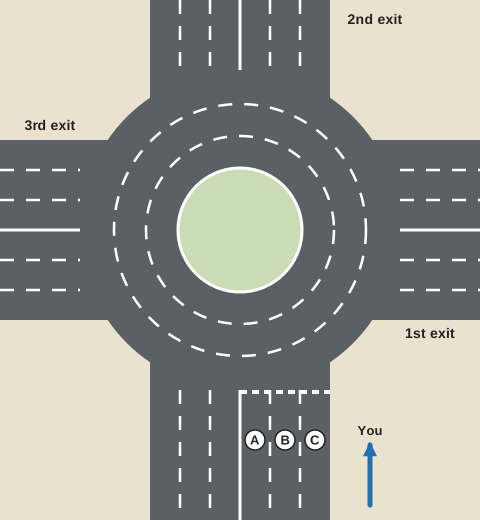
Question 19You approach this roundabout and want to take the 1st exit (turn right). Which lane should you use?
AB - the middle lane
BC - the right lane ✓(correct answer)
CA - the left lane
DAny lane
Correct answer: B. To turn right (1st exit), use lane 1 - the right lane - on approach, in the roundabout and when leaving.Source: Handbook p. 115
Question 20You approach this roundabout and want to go straight on (2nd exit). Which lane should you use?
AAny lane
BB - the middle lane ✓(correct answer)
CA - the left lane
DC - the right lane
Correct answer: B. Driving straight (2nd exit): use lane 2, the middle lane, if available.Source: Handbook p. 115
Question 21You approach this roundabout and want to take the 3rd exit (turn left). Which lane should you use?
AA - the left lane ✓(correct answer)
BB - the middle lane
CC - the right lane
DAny lane
Correct answer: A. Turning left (3rd exit): use lane 3, the left lane, if available.Source: Handbook p. 115
Question 22You want to go all the way round this roundabout and come back the way you came (4th exit). Which lane should you use?
AB - the middle lane
BA - the left lane ✓(correct answer)
CC - the right lane
DAny lane
Correct answer: B. A full rotation / U-turn (4th exit) uses lane 3, the left lane, if available.Source: Handbook p. 115
Question 23In a multi-lane roundabout, you are taking the 1st exit. Which lane should you be in while inside the roundabout?
AThe right (outer) lane ✓(correct answer)
BThe middle lane
CThe left (inner) lane
DChange to the inner lane, then back
Correct answer: A. For the 1st exit, stay in lane 1 (right lane) on approach, at the roundabout and on departure.Source: Handbook p. 115
Question 24You will take the 1st exit (right) at a roundabout. How should you signal?
ASignal right on approach and keep signalling right ✓(correct answer)
BNo signal at all
CSignal left on approach
DSignal right only after leaving
Correct answer: A. Turning right (1st exit): signal right on the approach and keep signalling right in the roundabout.Source: Handbook p. 116
Question 25You will go straight on (2nd exit) at a roundabout. How should you signal?
ANo signal at any point
BSignal left on approach
CNo signal on approach; signal right after passing the 1st exit ✓(correct answer)
DSignal right on approach
Correct answer: C. Driving straight: no signal on approach; start signalling right at the island of the 1st exit.Source: Handbook p. 116
Question 26You will take the 3rd exit (left) at a roundabout. How should you signal?
ANo signal on approach, then left
BSignal right on approach and keep it on
CSignal left on approach, then switch to right after passing the 2nd exit ✓(correct answer)
DSignal left the whole way, including when leaving
Correct answer: C. Turning left (3rd exit): signal left on approach and switch to the right signal at the island of the 2nd exit.Source: Handbook p. 116
Question 27You will take the 4th exit (U-turn) at a roundabout. When should you switch from the left signal to the right signal?
AYou should not signal right at all
BAfter passing the 3rd exit ✓(correct answer)
CAfter passing the 1st exit
DImmediately on entering
Correct answer: B. U-turn (4th exit): signal left on approach and switch to the right signal at the island of the 3rd exit.Source: Handbook p. 116
Question 28At a roundabout, what does the right-turn signal tell other drivers?
AThat you will go round it fully
BThat you are entering the roundabout
CThat you are about to leave the roundabout at the next exit ✓(correct answer)
DThat you are giving way to them
Correct answer: C. In every case you switch to (or keep) the right signal just before your exit, so the right signal shows you are leaving.Source: Handbook p. 116
Question 29Why should all drivers follow the roundabout lane and signal rules?
ASo no one ever needs to give way
BSo drivers can go faster than the limit
CBecause roundabouts have no signs
DSo traffic around the roundabout flows smoothly without problems ✓(correct answer)
Correct answer: D. If all drivers abide by these rules, traffic will flow smoothly around the roundabout.Source: Handbook p. 116