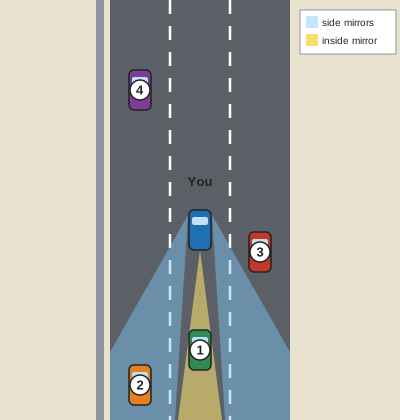
Changing lanes safely follows a fixed routine, and this topic helps you remember it. Check your mirrors first, signal, look over your shoulder to cover the blind spot, adjust your speed, and then move across with smooth steering. For the left lane, use the inside mirror and left outside mirror and check over your left shoulder; for the right lane, do the same on the right. Relying only on side mirrors can mean hitting a vehicle in your blind spot. You must also be sure that changing lanes is not prohibited and will not endanger anyone.
Question 1Which of these is a reason to change lanes listed in the handbook?
AKeeping other cars from overtaking
BGetting a better view of the scenery
CChoosing the correct lane before turning ✓(correct answer)
DTesting your mirrors
Correct answer: C. Lane changes are needed to avoid obstacles, choose the correct lane before turning, overtake, or stop on the left side where allowed.Source: Handbook p. 103
Question 2When may you change lanes in order to stop on the left side of the road?
AWhenever you see a free space
BOnly where stopping on the left is allowed ✓(correct answer)
COnly at night
DNever, stopping on the left is always forbidden
Correct answer: B. Changing lanes to stop on the left side is listed, but only if the driver is allowed to do so.Source: Handbook p. 103
Question 3There is an obstacle in your lane ahead. What does the handbook list as a correct reason to move out of your lane?
ATo race the car next to you
BTo avoid the obstacle, after checking it is safe ✓(correct answer)
CTo block traffic behind the obstacle
DLane changes are only for overtaking
Correct answer: B. Obstacle avoidance is one of the cases where changing lanes is necessary.Source: Handbook p. 103
Question 4When should you signal a lane change?
AWhile moving across the line
BOnly if a car is directly behind you
CAfter you are in the new lane
DBefore you actually change lanes ✓(correct answer)
Correct answer: D. Your decision to change course must be indicated before you actually do so.Source: Handbook p. 103
Question 5Which statement about changing lanes is correct?
ASolid lines may be crossed if you change lanes slowly
BYou may change lanes anywhere if you signal
COnly trucks must check before changing lanes
DYou must be sure it is not prohibited and won't endanger you or others ✓(correct answer)
Correct answer: D. Make sure the lane change is not prohibited and can be done without endangering yourself or other road users, and show your intent clearly.Source: Handbook p. 103
Question 6In this picture, which car is in your blind spot (not visible in your mirrors or through the windscreen)?
ACar 4
BCar 3 ✓(correct answer)
CCar 1
DCar 2
Correct answer: B. Car 3 is beside your rear quarter, outside the area covered by the inside and side mirrors - your blind spot. Only a shoulder check shows it.Source: Handbook p. 104
Question 7How can you see a vehicle that is in your blind spot?
ABy checking the side mirror twice
BBy looking at the dashboard
CBy looking over your shoulder through the side window ✓(correct answer)
DBy checking the inside mirror
Correct answer: C. Vehicles in the blind spot can only be seen by looking over your shoulder.Source: Handbook p. 104
Question 8What can happen if you rely only on your side mirrors when changing lanes?
AYou will always change lanes too slowly
BYour mirrors may break
CNothing, side mirrors show everything
DYou may hit a vehicle in your blind spot ✓(correct answer)
Correct answer: D. If you rely only on the side mirrors, you may soon hit a vehicle in your blind spot.Source: Handbook p. 104
Question 9What is the correct order of actions before changing lanes?
Correct answer: C. Check the mirrors first, then signal, then check the blind spot over your shoulder, adjust speed, and then change lanes.Source: Handbook p. 105
Question 10What is the FIRST thing to do before changing lanes?
ACheck your mirrors ✓(correct answer)
BTurn the steering wheel
CAccelerate
DLook over your shoulder
Correct answer: A. You should always check your mirrors first, then signal, then the shoulder check.Source: Handbook p. 105
Question 11You have checked your mirrors and signalled. What comes next before you move across?
ASwitch off the signal
BCheck the speedometer only
CLook over your shoulder to check the blind spot ✓(correct answer)
DMove immediately into the lane
Correct answer: C. After mirrors and signal comes the shoulder (blind spot) check, then speed, then changing lanes.Source: Handbook p. 105
Question 12How should your steering change as your speed increases?
AFaster speeds need sharper steering
BSteer with one hand at high speed
CSteering doesn't matter at high speed
DThe faster you drive, the more carefully and smoothly you must steer ✓(correct answer)
Correct answer: D. The handbook reminds: the faster you drive, the more safely (smoothly) you have to steer.Source: Handbook p. 105
Question 13You want to move to the LEFT lane. Which mirrors should you check?
AThe inside mirror and the right outside mirror
BThe inside mirror and the left outside mirror ✓(correct answer)
COnly the right outside mirror
DNo mirrors, only the shoulder check
Correct answer: B. For a lane change to the left: inside mirror + left outside mirror, signal left, left shoulder check, adapt speed, steer smoothly.Source: Handbook p. 106
Question 14Changing to the left lane, which shoulder check is needed?
ALook in the inside mirror only
BLook over your right shoulder
CNo shoulder check is needed when moving left
DLook over your left shoulder ✓(correct answer)
Correct answer: D. Moving left: check the left blind spot over your left shoulder.Source: Handbook p. 106
Question 15You want to move to the RIGHT lane. What is the correct sequence?
AInside and right mirrors, signal right, right shoulder check, adapt speed, steer smoothly ✓(correct answer)
BLeft mirror, signal left, left shoulder, steer right
CRight shoulder check, steer, then signal
DSignal right, steer right, then check mirrors
Correct answer: A. Moving right: inside mirror and right outside mirror, signal right, right shoulder, adapt the speed, move with smooth steering.Source: Handbook p. 107
Question 16How should the steering movement be when changing lanes?
AIn several short jerks
BWith the hand-brake applied
CQuick and sharp
DSmooth ✓(correct answer)
Correct answer: D. Change lanes with smooth steering motions.Source: Handbook p. 106