This topic covers everyday rules of the road. Vehicles must stay on the paved part of the road, keep to the right-hand lane on a two-way road and move to the far right when visibility is poor or when another car is overtaking. A broken centre line may be crossed only to overtake when safe, while a double continuous line must never be crossed. Slow vehicles should stay in the far-right lane on multi-lane roads. Driving on the left is allowed only to overtake or prevent an accident, and on narrow roads you should keep right and stop if needed.
Question 1On which part of the road must vehicles always be driven?
AThe paved part of the road ✓(correct answer)
BThe sidewalk, if it is empty
CThe shoulder, when traffic is heavy
DAny flat surface next to the road
Correct answer: A. Vehicles must always be driven on the paved part of the road.Source: Handbook p. 96
Question 2When may a driver disregard a normal traffic light?
AOnly when a traffic man directs otherwise ✓(correct answer)
BWhen no other cars are around
CWhen the light has been red for a long time
DAt night after midnight
Correct answer: A. The driver must obey all normal traffic lights unless directed otherwise by a traffic man.Source: Handbook p. 96
Question 3Which of these is one of the general driving rules?
ASpeed up when another vehicle tries to overtake you
BAlways drive in the left lane on open roads
CDo not exceed the speed limit and allow other vehicles to pass safely ✓(correct answer)
DUse the shoulder to avoid queues
Correct answer: C. General rules: drive on the paved road, obey traffic lights, don't exceed the speed limit, and allow other vehicles to pass safely.Source: Handbook p. 96
Question 4A car behind you is starting to overtake. What should you do?
ABrake sharply to warn it
BSpeed up so it can't pass
CMove toward the centre line
DKeep to the far right and let it pass safely ✓(correct answer)
Correct answer: D. You must allow other vehicles to pass safely and stay on the far right when others are about to overtake you.Source: Handbook p. 101
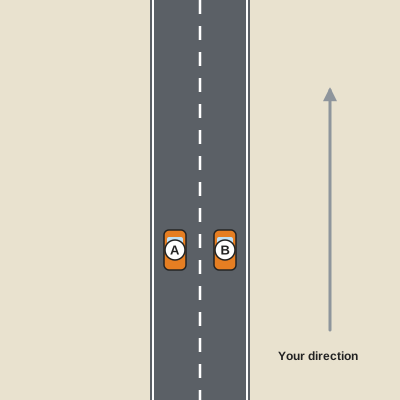
Question 5You are driving in the direction of the grey arrow on this two-way road. Which position is correct?
AEither lane, as long as the road is clear
BStraddling the centre line
CA - in the left-hand lane
DB - in the right-hand lane ✓(correct answer)
Correct answer: D. On a two-way road divided by a broken line you must drive in the right lane.Source: Handbook p. 97
Question 6On a two-way road divided by a broken (dashed) line, when may you cross into the other lane?
ANever, under any circumstances
BTo drive faster than the limit
COnly to overtake the vehicle in front ✓(correct answer)
DWhenever the right lane is bumpy
Correct answer: C. You drive in the right lane and do not cross the broken line unless you want to overtake.Source: Handbook p. 97
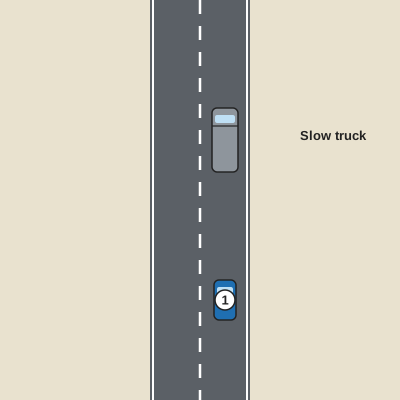
Question 7You (car 1) are behind a slow truck on this road with a broken centre line. The way ahead is clear and overtaking is not otherwise prohibited. May you cross the line to overtake?
AOnly if the truck is on the shoulder
BYes, a broken line may be crossed to overtake when it is safe ✓(correct answer)
COnly if you sound your horn first
DNo, centre lines may never be crossed
Correct answer: B. A broken line may be crossed to overtake a vehicle in front, provided it is safe.Source: Handbook p. 97
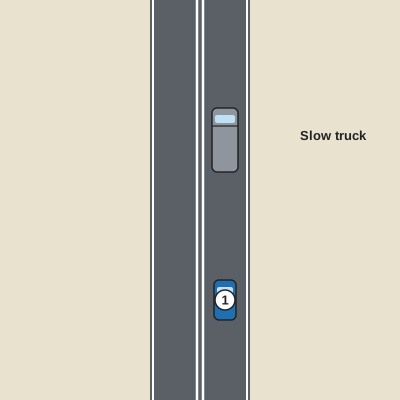
Question 8You (car 1) are behind a slow truck. The road is divided by a double continuous line. May you cross it to overtake?
ANo, crossing a double continuous line is prohibited ✓(correct answer)
BYes, if you overtake quickly
CYes, if the opposite lane is empty
DYes, but only during the day
Correct answer: A. When a road is divided by a double continuous line, drivers are prohibited from crossing it to the other lane.Source: Handbook p. 98
Question 9What does a double continuous line between two opposite lanes mean?
AYou must not cross it ✓(correct answer)
BYou may cross it only at night
CYou may cross it to overtake
DIt marks a parking area
Correct answer: A. Drivers are prohibited from crossing a double continuous line to the other lane.Source: Handbook p. 98
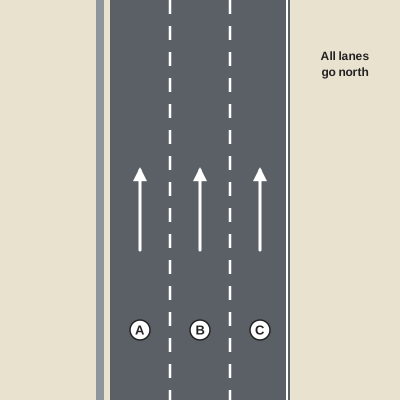
Question 10You drive a slow, heavily loaded truck on this three-lane road (all lanes go the same way) and do not plan to turn. Which lane must you use?
AA - the far-left lane
BAny lane, as long as you stay in it
CC - the far-right lane ✓(correct answer)
DB - the middle lane
Correct answer: C. Slower vehicles must use the lane on the far right unless preparing to turn left or make a U-turn.Source: Handbook p. 99
Question 11On a multi-lane road, when may a slow vehicle leave the far-right lane?
AWhen preparing to turn left or make a U-turn ✓(correct answer)
BNever, slow vehicles must always stay right
CWhen the driver wants a smoother ride
DWhenever the left lane is empty
Correct answer: A. Slower vehicles must use the far-right lane unless preparing to turn left or reverse direction (U-turn).Source: Handbook p. 99
Question 12On a road divided into several lanes in one direction, may vehicles drive side by side?
AYes, in parallel in their lanes ✓(correct answer)
BNo, vehicles must drive in a single line
COnly on roads without lane markings
DOnly trucks may drive side by side
Correct answer: A. If the road is divided into several lanes, vehicles can go side by side in parallel on those lanes.Source: Handbook p. 99
Question 13What must you do before changing lanes on a multi-lane road?
ASound the horn continuously
BMake sure it endangers no one and clearly show your intention ✓(correct answer)
CSlow down to a stop before moving
DChange lanes first, then signal
Correct answer: B. Before changing lanes, ensure it doesn't endanger others, and clearly show your intent and warn others. Traffic is efficient when drivers follow the rules.Source: Handbook p. 99
Question 14In which situation must you stay on the far right side of the road?
AWhen you want to overtake
BWhen visibility is poor ✓(correct answer)
CWhen you want to turn left on a two-way road
DWhen you are driving faster than other traffic
Correct answer: B. Stay far right when turning right, when others are about to overtake, when slower than the limit, when vision is poor, and when vehicles approach from the other direction.Source: Handbook p. 101
Question 15You are driving below the speed limit on a two-lane road and an oncoming car approaches. Where should you be?
AOn the left side of the road
BOn the shoulder, stopped
CNear the centre line
DOn the far right side of the road ✓(correct answer)
Correct answer: D. Being slower than the limit and having oncoming vehicles are both reasons to keep to the far right.Source: Handbook p. 101
Question 16When is driving on the left side of the road permitted?
AWhen you are late
BWhen driving at night
CTo overtake, where overtaking is permitted and can be done without endangering others ✓(correct answer)
DWhenever the right side is congested
Correct answer: C. Left-side driving is only allowed to prevent accidents, to overtake safely where permitted, or when the right side is blocked and you are signalled to pass.Source: Handbook p. 102
Question 17Part of the right side of the road is blocked by a construction site, and a road worker signals you to pass on the left. What should you do?
AWait until the construction is finished
BReverse and find another road
CDrive on the sidewalk to the right
DPass carefully on the left as signalled ✓(correct answer)
Correct answer: D. Driving on the left is permitted when the right side is blocked (e.g. construction) and traffic police, security forces or road workers signal you to pass.Source: Handbook p. 102
Question 18Which is a valid reason to drive on the left side of the road?
AIt is necessary to prevent an accident, without impeding or endangering others ✓(correct answer)
BYou want to stay close to the centre line
CThe left side has a smoother surface
DYou plan to turn right soon
Correct answer: A. One permitted case is when it is necessary to prevent accidents, as long as it does not impede or endanger other road users.Source: Handbook p. 102
Question 19You meet oncoming traffic on a narrow road. What should you do?
ADrive in the middle so they slow down
BSpeed up to pass them quickly
CKeep to the far right and stop if necessary until the oncoming vehicles pass ✓(correct answer)
DSound the horn so they move aside
Correct answer: C. On narrow roads stay on the far right to leave enough room, stop if necessary, and use the horn only when absolutely necessary.Source: Handbook p. 102
Question 20On narrow roads, when should you use the horn?
AOnly when absolutely necessary ✓(correct answer)
BWhenever a vehicle approaches
CBefore every bend
DTo ask oncoming cars to give way
Correct answer: A. The handbook says not to use the horn on narrow roads except when absolutely necessary.Source: Handbook p. 102
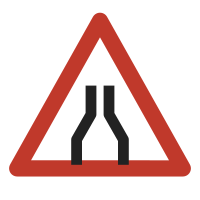
Question 21What does this warning sign mean?
ALanes merge from the right
BBridge ahead
CThe road narrows on both sides ✓(correct answer)
DTwo-way traffic ahead
Correct answer: C. This triangular warning sign shows the road becoming narrower from both sides; keep right and be ready to let oncoming traffic pass.Source: Handbook p. 102