This topic looks at how speed limits work. Without another sign, small vehicles must drive no faster than the speed set for the road, and the handbook gives 50 km/h as the maximum for large vehicles on city roads. A limit sign stays in force until another sign changes it or an end-of-limit sign appears. Red-bordered numbers show a maximum speed and blue round signs a minimum. Limits are maximums, so reduce speed at night, in fog, sandstorms or dazzling sunlight. Only emergency vehicles may exceed limits, and only if they do not endanger others.
Question 1You drive a small vehicle on a highway with no other speed sign. How fast may you drive?
AAlways 140 km/h
BNo faster than the speed specified for that road ✓(correct answer)
CAs fast as traffic allows
DAlways 80 km/h
Correct answer: B. For small vehicles, on both sub-roads and highways, you follow the speed specified for the road.Source: Handbook p. 162
Question 2What is the maximum speed for large vehicles on city roads (no other limit shown)?
A50 km/h ✓(correct answer)
B70 km/h
C30 km/h
D80 km/h
Correct answer: A. Large vehicles may drive at a maximum of 50 km/h on roads within cities unless another limit is shown.Source: Handbook p. 163
Question 3A truck driver leaves the city onto an open road. What speed limit applies now?
ANo limit for trucks outside cities
BThe speed specified for that road ✓(correct answer)
CAlways 60 km/h
DStill 50 km/h
Correct answer: B. Inside cities large vehicles are limited to 50 km/h; outside city limits they follow the road's specified speed.Source: Handbook p. 163
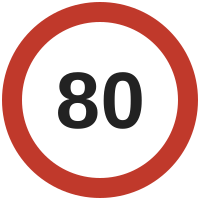
Question 4What does this sign mean?
ARecommended speed 80 km/h
BMinimum speed 80 km/h
CMaximum speed 80 km/h ✓(correct answer)
DEnd of the 80 km/h limit
Correct answer: C. A white circle with a red border and a number is a maximum speed limit sign.Source: Handbook p. 164
Question 5You pass a maximum speed sign and no other speed sign follows. What applies?
AThe limit applies only to trucks
BYou may return to your usual speed after the next junction
CThe limit ends after 1 km
DYou must keep to the limit shown on that sign ✓(correct answer)
Correct answer: D. If there is no other speed limiter, you must stick to the limit after this sign.Source: Handbook p. 164
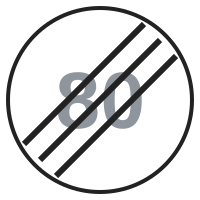
Question 6What does this sign mean?
ANo overtaking above 80 km/h
BSpeed limit 80 km/h starts
CEnd of the 80 km/h speed limit ✓(correct answer)
DMinimum speed 80 km/h
Correct answer: C. A white sign with the number crossed by black diagonal lines marks the end of that speed limit.Source: Handbook p. 164
Question 7A sign shows a limit of 120 km/h. What is correct?
AYou may drive up to 130 km/h
BYou must drive at 120 km/h
C120 km/h is the maximum; you are not required to drive that fast ✓(correct answer)
DYou must drive at least 100 km/h
Correct answer: C. Don't feel compelled to drive fast - these signs just show the limit.Source: Handbook p. 164
Question 8In which situation must you reduce your speed below the posted limit?
AOn an empty highway in daylight
BAt night ✓(correct answer)
COn a clear, dry morning
DWhen your car is newly serviced
Correct answer: B. The handbook lists night and strong sunlight as situations requiring reduced speed.Source: Handbook p. 165
Question 9You are driving toward strong, low sunlight that dazzles you. What should you do?
AReduce your speed ✓(correct answer)
BSwitch on hazard lights and keep your speed
CSpeed up to get out of the glare quickly
DKeep your speed and follow the car ahead closely
Correct answer: A. Strong sunlight is one of the situations in which speed must be reduced.Source: Handbook p. 165
Question 10A sandstorm starts while you are driving on the highway. What should you do?
AReduce speed below the posted limit ✓(correct answer)
BKeep exactly the posted speed
CStop in the middle of the lane
DSpeed up to get through it
Correct answer: A. During fog, rain and sandstorms, and according to road conditions, speed must be reduced.Source: Handbook p. 166
Question 11Which weather condition requires you to reduce speed?
ACloudy but dry weather
BClear skies
CLight wind on a dry road
DFog ✓(correct answer)
Correct answer: D. Speed must be reduced during fog, rain and sandstorms.Source: Handbook p. 166
Question 12Who may exceed the speed limit?
ADrivers late for an appointment
BEmergency vehicles, as long as they do not endanger others ✓(correct answer)
CTaxis carrying passengers
DAny vehicle on an empty highway
Correct answer: B. Emergency vehicles can exceed the speed limit, but this should not endanger the safety of others.Source: Handbook p. 167
Question 13Why should you always be aware of what is happening around you while driving?
ASo you can follow other cars closely
BSo you can drive faster
CSo you can let emergency vehicles pass easily ✓(correct answer)
DSo you can use your phone safely
Correct answer: C. Awareness of your surroundings lets you allow emergency vehicles to pass easily.Source: Handbook p. 167
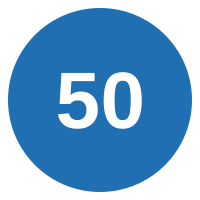
Question 14What does this blue round sign mean?
ARecommended speed for trucks
BEnd of the 50 km/h limit
CMaximum speed 50 km/h
DMinimum speed 50 km/h - do not drive slower than this ✓(correct answer)
Correct answer: D. Blue round signs with a number indicate a minimum speed.Source: Handbook p. 168
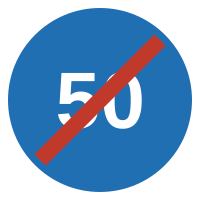
Question 15What does this sign mean?
AMaximum speed 50 km/h is cancelled for cars only
BDriving at 50 km/h is prohibited
CEnd of the minimum speed of 50 km/h ✓(correct answer)
DMinimum speed 50 km/h starts
Correct answer: C. A blue minimum-speed sign crossed with a red diagonal line marks the end of the minimum speed.Source: Handbook p. 168
Question 16What is the difference between a round sign with a red border and a number, and a blue round sign with a number?
ABoth show the maximum speed
BRed border is for cars, blue is for trucks
CRed border = maximum speed; blue = minimum speed ✓(correct answer)
DRed border = minimum speed; blue = maximum speed
Correct answer: C. A red-bordered circle sets the maximum speed; a blue circle sets the minimum speed.Source: Handbook p. 168