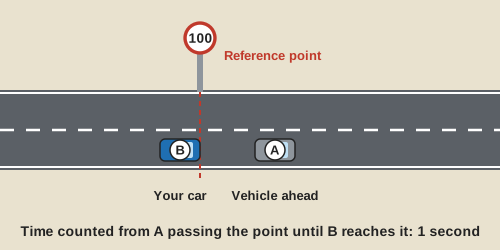
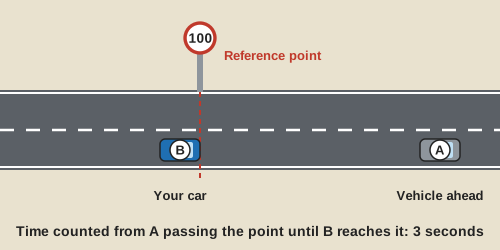
The handbook sets the minimum following distance behind another vehicle at two seconds. To check it, choose a fixed reference point such as a tree, mast or sign, start counting when the rear of the vehicle ahead passes it, and stop when the front of your vehicle reaches it. Counting only one second means you are too close and must drop back; three seconds meets the minimum. In rain or blowing dust, leave more than two seconds. A bigger gap gives you more time to react, less pressure on the pedals and more relaxed driving.
Question 1What is the minimum following distance behind another vehicle?
AHalf a second
BOne second
CTen seconds
DTwo seconds ✓(correct answer)
Correct answer: D. The minimum distance to drive behind another vehicle is two seconds.Source: Handbook p. 183
Question 2When is it especially important to check your following distance regularly?
AOnly when parking
BOnly in a traffic jam
CWhen driving at higher speeds, such as on the highway or open road ✓(correct answer)
DOnly at traffic lights
Correct answer: C. Check the following distance regularly, especially at higher speeds behind other vehicles.Source: Handbook p. 184
Question 3Which could you use as a reference point for the two-second rule?
AYour speedometer needle
BA tree, mast, sign or shadow next to the road ✓(correct answer)
CThe centre of your steering wheel
DThe car directly behind you
Correct answer: B. Choose a fixed reference point such as a traffic light, tree, mast, sign or a shadow on the road.Source: Handbook p. 184
Question 4When do you START counting in the two-second rule?
AWhen you see the reference point in the distance
BWhen the front of your car passes the reference point
CWhen the car ahead brakes
DWhen the rear of the vehicle ahead passes the reference point ✓(correct answer)
Correct answer: D. Start counting when the back of the vehicle in front of you is at the reference point.Source: Handbook p. 184
Question 5When do you STOP counting in the two-second rule?
AWhen the rear of your car passes the point
BAfter exactly two seconds, whatever happens
CWhen the vehicle ahead disappears from view
DWhen the front of your vehicle reaches the reference point ✓(correct answer)
Correct answer: D. Keep counting until the front of your vehicle reaches the reference point; it must take at least two seconds.Source: Handbook p. 184
Question 6The car ahead passed a tree. You counted 'one thousand one' and your car reached the same tree. What does this mean?
AYour distance is safe
BYour distance is not safe - drop back ✓(correct answer)
CYou should overtake now
DYou are too far behind
Correct answer: B. You counted only one second. You must count at least two seconds, otherwise the distance is not safe.Source: Handbook p. 184
Question 7In the diagram, the time between car A passing the reference point and your car B reaching it was 1 second. What should you do?
ANothing; one second is enough
BIncrease the distance to at least two seconds ✓(correct answer)
COvertake car A immediately
DClose up to the car ahead
Correct answer: B. One second is below the two-second minimum, so the distance is not safe.Source: Handbook p. 184
Question 8In the diagram, the time between car A passing the reference point and your car B reaching it was 3 seconds. Is the distance safe?
AYes, it is at least the two-second minimum ✓(correct answer)
BIt depends only on the speed limit sign
CNo, it must be at least 5 seconds
DNo, you are too far and must close up
Correct answer: A. Three seconds is more than the two-second minimum, so the distance is safe (in good conditions).Source: Handbook p. 184
Question 9It starts raining and dust is blowing. What should you do with your following distance?
AKeep exactly two seconds
BFollowing distance doesn't change with weather
CLeave a larger distance than two seconds ✓(correct answer)
DReduce it to stay close to the car ahead
Correct answer: C. Leave a larger distance in changing weather such as storms, dust, rain and poor road conditions.Source: Handbook p. 185
Question 10What is the benefit of keeping a large following distance and looking ahead?
AYou don't need to use mirrors
BYou can drive faster in traffic
CMore time to respond to dangers, less pressure on the gas pedal and more safety ✓(correct answer)
DOther drivers cannot cut in
Correct answer: C. A large distance and looking forward give more time to respond, less pressure on the gas and more safety.Source: Handbook p. 186